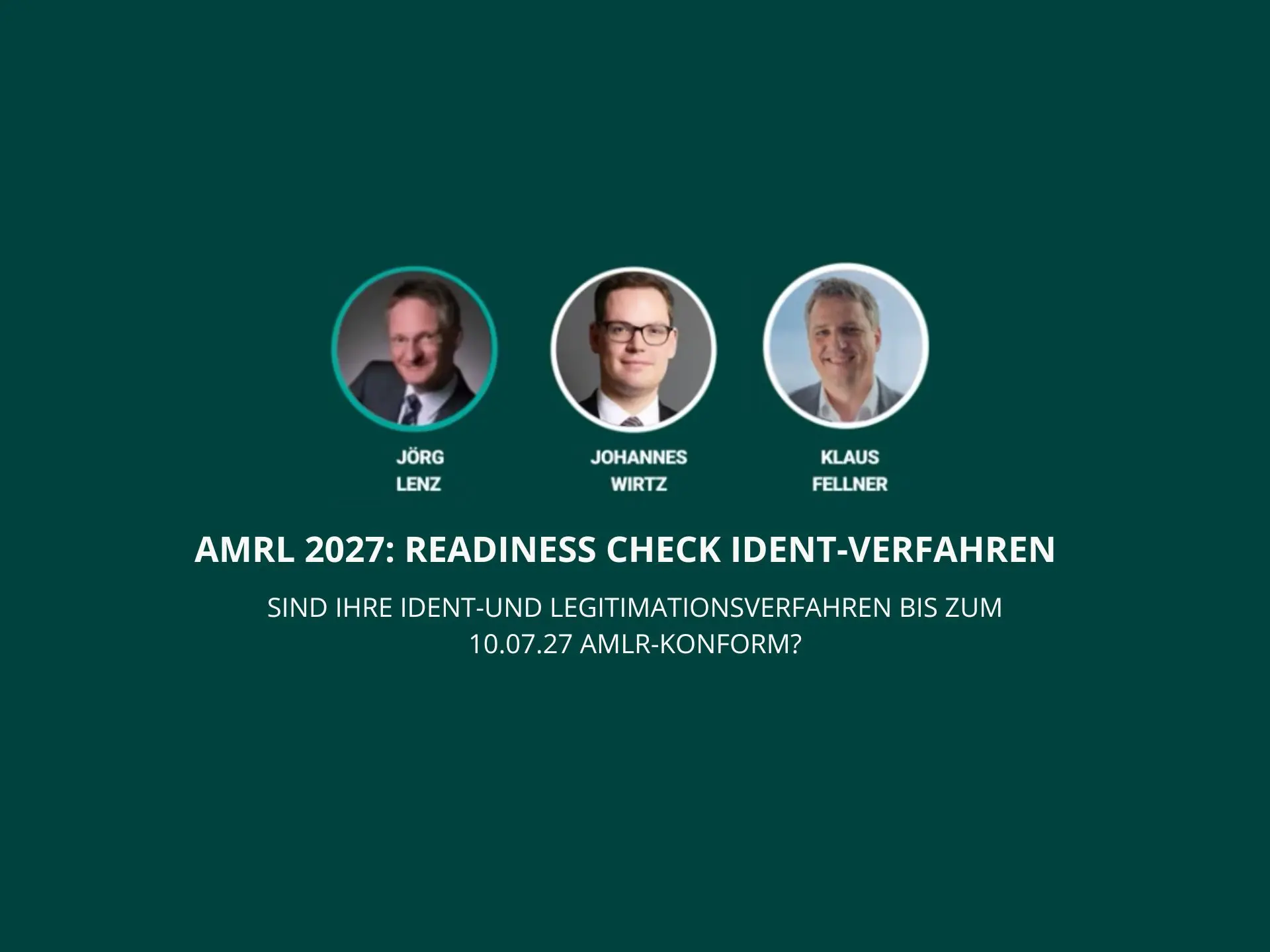
Are your identification and legitimation procedures AMLR-compliant by July 10, 2027? With the direct applicability of the EU Anti-Money Laundering Regulation (AMLR, Regulation (EU) 2024/1624), new standards for how obliged entities must identify their customers apply from this date. This webinar, hosted by Namirial on July 10, 2026 as part of the Namirial Sommerakademie 2026, gives professionals and executives in Compliance, KYC, and Legal a practical overview of the regulatory requirements and a concrete readiness check for their own identification processes.
The event was moderated by Jörg Lenz, Head of Marketing & Communications at Namirial. Johannes Wirtz, LL.M. (Bird & Bird, Frankfurt), assessed the legal situation from a vendor-independent perspective. Klaus Fellner, Managing Director of Namirial GmbH, translated the regulatory requirements into compliant, verifiable identification and signature processes for practical application.
Context
July 10, 2026 marks two regulatory milestones at once: on this day, AMLA submitted its first package of regulatory technical standards (RTS) on customer due diligence obligations to the European Commission – consolidating the AMLR’s requirements into binding Level 2 standards. At the same time, the Digital Identities Act (DIdG) appeared on the Bundesrat’s agenda for the first time. The DIdG is expected to amend the GwG as early as Q4 2026, effectively bringing forward the AMLR’s impact to the end of 2026: the EUDI Wallet will be recognized as an approved identification means under Section 12(1) GwG, and the requirement for a reference transfer will be dropped.
The AMLR makes eIDAS the reference standard for customer identification: electronic identification means with a “substantial” or “high” level of assurance, the EUDI Wallet, and qualified trust services such as QES are compliant by definition and, under the draft RTS, are to be preferred. VideoIdent becomes a fallback subject to justification and evidentiary requirements – with concrete consequences for provider selection, documentation obligations, and liability.
Key topics of the webinar
The new obligations under Art. 22 AMLR and the AMLA RTS – Johannes Wirtz explained the structure of the new due diligence obligations: the preferred digital route via eIDAS-compliant procedures and the conditions under which other remote identification procedures remain permissible. Customer preference is not a valid reason for using the fallback.
VideoIdent: from standard to a fallback requiring justification – What is regarded today as an established, BaFin-recognized procedure becomes, from July 10, 2027, an exception requiring justification – with an expanded mandatory data set and an ongoing documentation requirement toward the supervisory authority.
ETSI TS 119 461 v2.1.1 as the new reference standard – For QES-based remote identification, eIDAS Art. 24 requires the LoIP Extended profile with certified biometric components: 1:1 facial recognition, liveness detection (PAD), and injection attack detection (IAD). These certifications form the robust proof of compliance toward the supervisory authority.
Supervision, sanctions, and proof of compliance – With the AMLR, a supranational AML supervisory authority at EU level emerges for the first time. AMLA operates alongside BaFin. Documented, certified procedures reduce liability and sanction risk and, under Art. 7(4) of the draft RTS, form the basis for demonstrating compliance to the competent authority.
Roadmap to July 10, 2027 – A role-specific readiness check – CCOs and MLROs, Heads of KYC, and CTOs and IT leaders receive concrete next steps for the period from H2 2026 through the deadline.
The webinar was held in German.
Enter the password to access the recording.
If you don’t know the password, please fill out the form below to receive it by email.