
On 2 January 2027, d-you, Germany’s state-provided European Digital Identity Wallet, goes live, the first wallet of its kind with others (including several EUDI Wallets by private providers) to follow in 2028. At the Smart Country Convention in Berlin in mid-October, Common Codes presented the roadmap from sandbox to launch. Common Codes is the company that runs the national wallet project on behalf of the Federal Ministry for Digital Transformation and Government Modernisation (BMDS) since 1 September. The German Parliament (Deutscher Bundestag) adopted the Digital Identities Act (DIdG) on 15 October; the Bundesrat is expected to deal with no later than in the last session of this year on 18 December, as the DidG must enter into force prior to d-you going live.
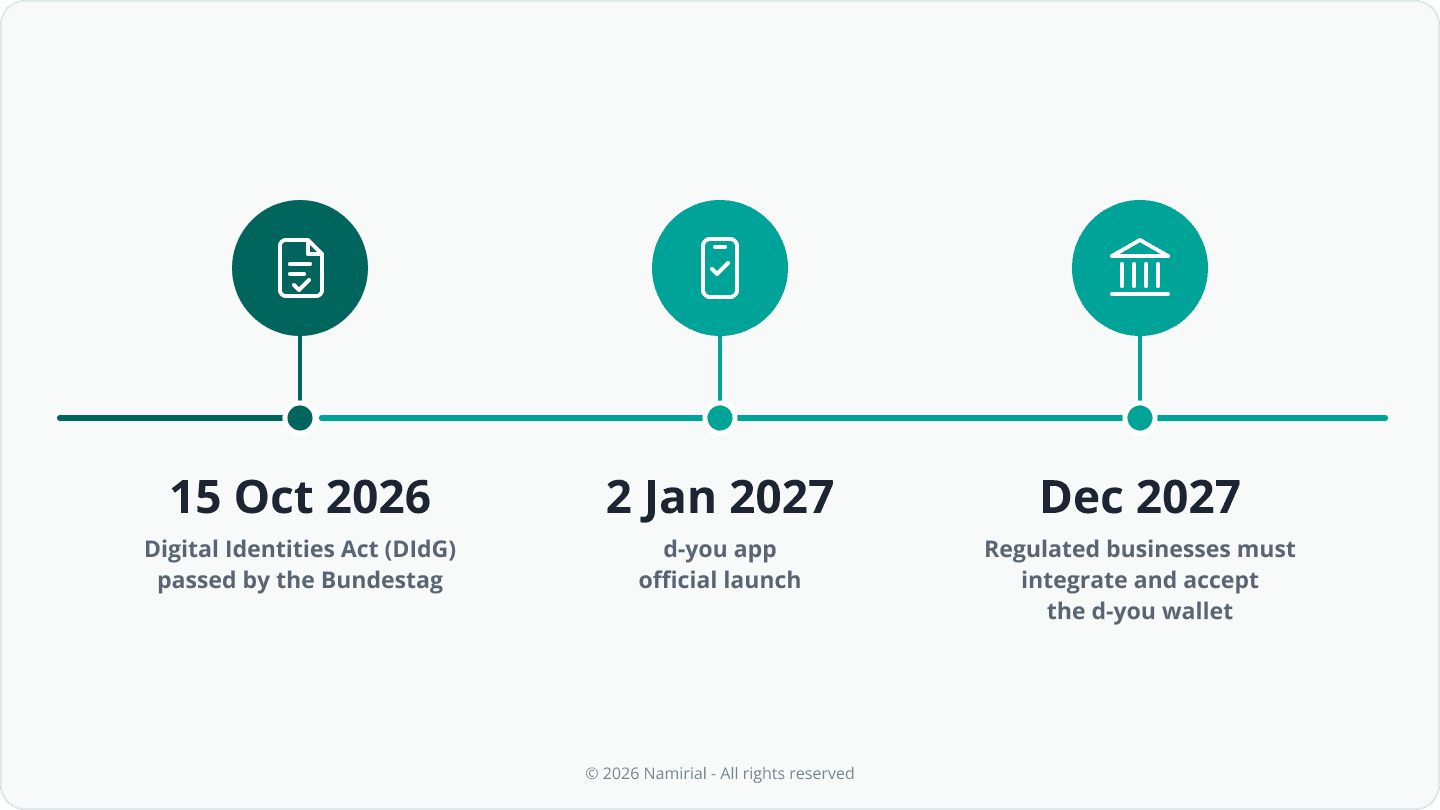
What starts in January is the first stage of the state wallet under national law. EU certification under eIDAS is to follow once the full functional scope is in place. For banks, insurers, public authorities and other relying parties, the start is therefore a beginning, not a finished product. Here are eight takeaways for planning 2027.
1 | Germany is building an ecosystem, not an app
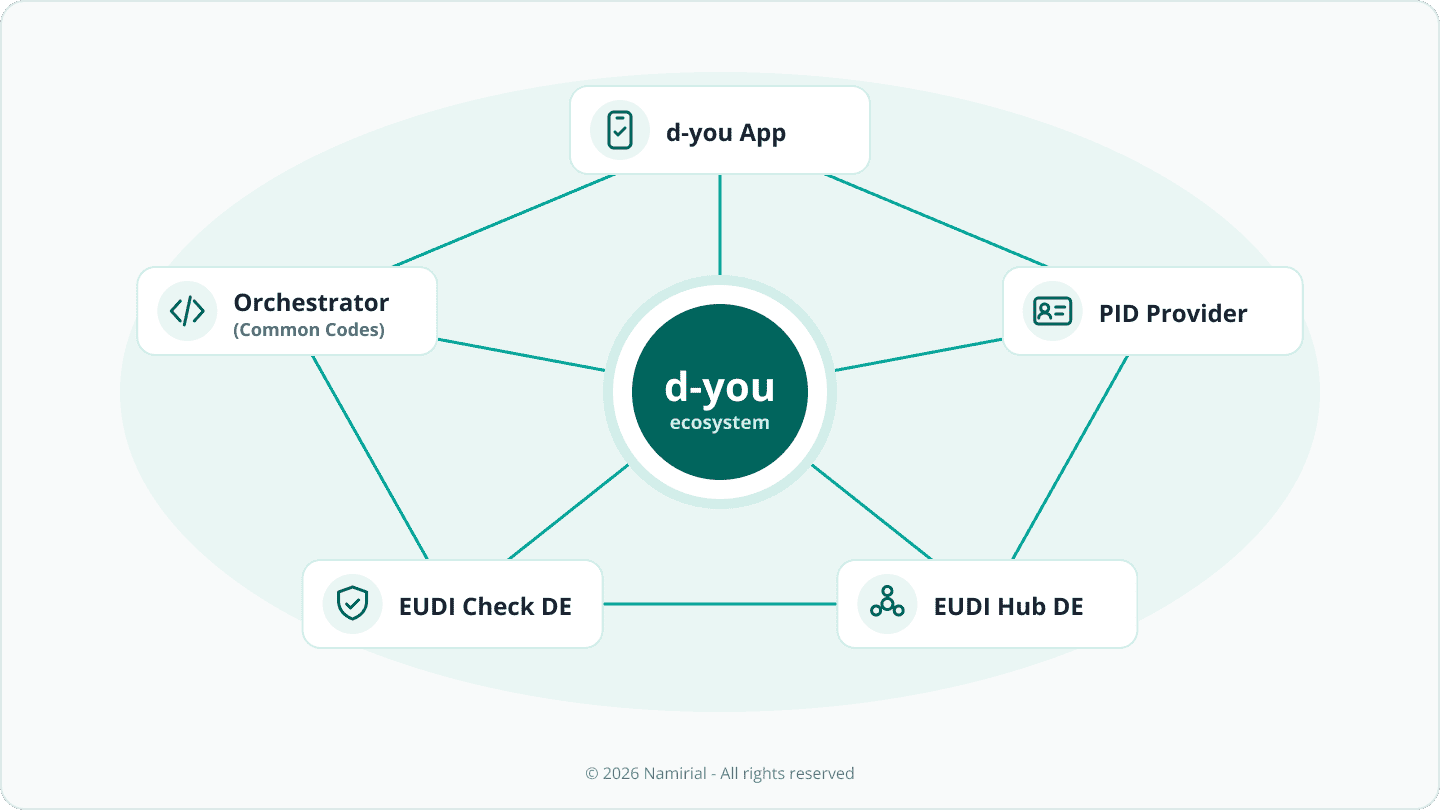
Alongside the d-you app, the national project comprises a PID provider, which issues the digital identity as the anchor credential, the EUDI Hub DE for managing ecosystem participants, and the EUDI Check DE app for verifying credentials in person. Common Codes acts as orchestrator, a role the government draft of the DIdG allows the BMDS to delegate. Until September the project was run by the Federal Agency for Disruptive Innovation (SPRIN-D). According to Common Codes, more than 270 partners are active in the sandbox, with over 330 use cases in pilot operation; more than 40 partners are expected to be live at launch.
What this means: Relying parties are not integrating a single app. They are joining a governed system with registration, access certificates and defined onboarding steps. Planning should start with that process, not with the user interface.
2 | The state is removing a practical barrier
One of the most practical barriers has been addressed with a solution recently: d-you is set up with the online function of the German ID card and its PIN. In a Bitkom survey published in April 2026, 21 % of respondents had the online function activated but no longer knew their PIN; only 18 % had it activated and knew it. In October, the BMDS reinstated a free PIN reset and activation service by letter, so citizens no longer need to visit a local office. Municipalities, on the other hand, are still asking who pays for connecting their services: funding was the most frequent concern in a survey of local authorities by the CDU/CSU parliamentary group in July 2026.
What this means: The state carries the infrastructure. Integration into business processes remains with the relying parties, and that is where both the effort and the value lie.
3 | Solving the chicken-and-egg problem
Users adopt a wallet only if they can use it somewhere, and relying parties invest only where there are users. Common Codes names this chicken-and-egg problem itself and has asked sandbox partners for strong engagement. Germany’s starting point is unusual. According to the eGovernment MONITOR 2026 of Initiative D21, 29 % of respondents have used the online ID function at least once. That is low, but it also means the government does not have to manage the transition from a widely used national scheme, as Italy does with SPID or Poland with mObywatel. The wallet can be introduced without switching costs.
What this means: Early use cases decide adoption. Namirial supports relying parties with onboarding and journey orchestration – from identification via wallet presentation to qualified signature – so that their use cases are ready for the first wave of users.
4 | Banks and insurers move first
According to Common Codes, 54 of the use cases in the sandbox come from finance and insurance, more than from any other private-sector field. The regulatory calendar explains why. The DIdG recognises the EUDI Wallet as a means of identification under the German Anti-Money Laundering Act (GwG). The EU Anti-Money Laundering Regulation (AMLR) applies from 10 July 2027, and the final draft of the AMLA regulatory technical standards on customer due diligence of 30 September 2026 refers to EU Digital Identity Wallets. Matteo Panfilo has analysed the details in the blog post “Customer Due Diligence, AMLA’s Final RTS: What’s Changing for KYC and Remote Onboarding”.
Yet the PID alone does not complete an onboarding. It confirms who the customer is, but a bank or insurer needs more: the tax identification number where the AMLR requires it, a verified registered address, information on occupation and the purpose of the business relationship and, for payouts or direct debits, a verified IBAN. Some of these data will reach the wallet as attestations – an IBAN credential for direct debits is among the use cases presented for launch – while others will continue to come from the customer and from the relying party’s own checks.
What this means: Whoever builds a wallet-based onboarding journey now is also building the KYC journey the AMLR will require – provided the journey combines the PID with further attestations and data. The bottleneck remains official attestations beyond identity, such as tax ID or registered address, for which there is no nationwide timetable yet.
5 | Awareness is low, interest is there
In a Bitkom survey published on 15 October, 53 % of respondents said they want to use the wallet (20 % definitely, 33 % probably). At the same time, 46 % had never heard of the EUDI Wallet, and only 8 % could explain it well. The D21 eGovernment MONITOR 2026 shows that the habit already exists: 45 % use a wallet on their smartphone, and 62 % would like a uniform digital identification.
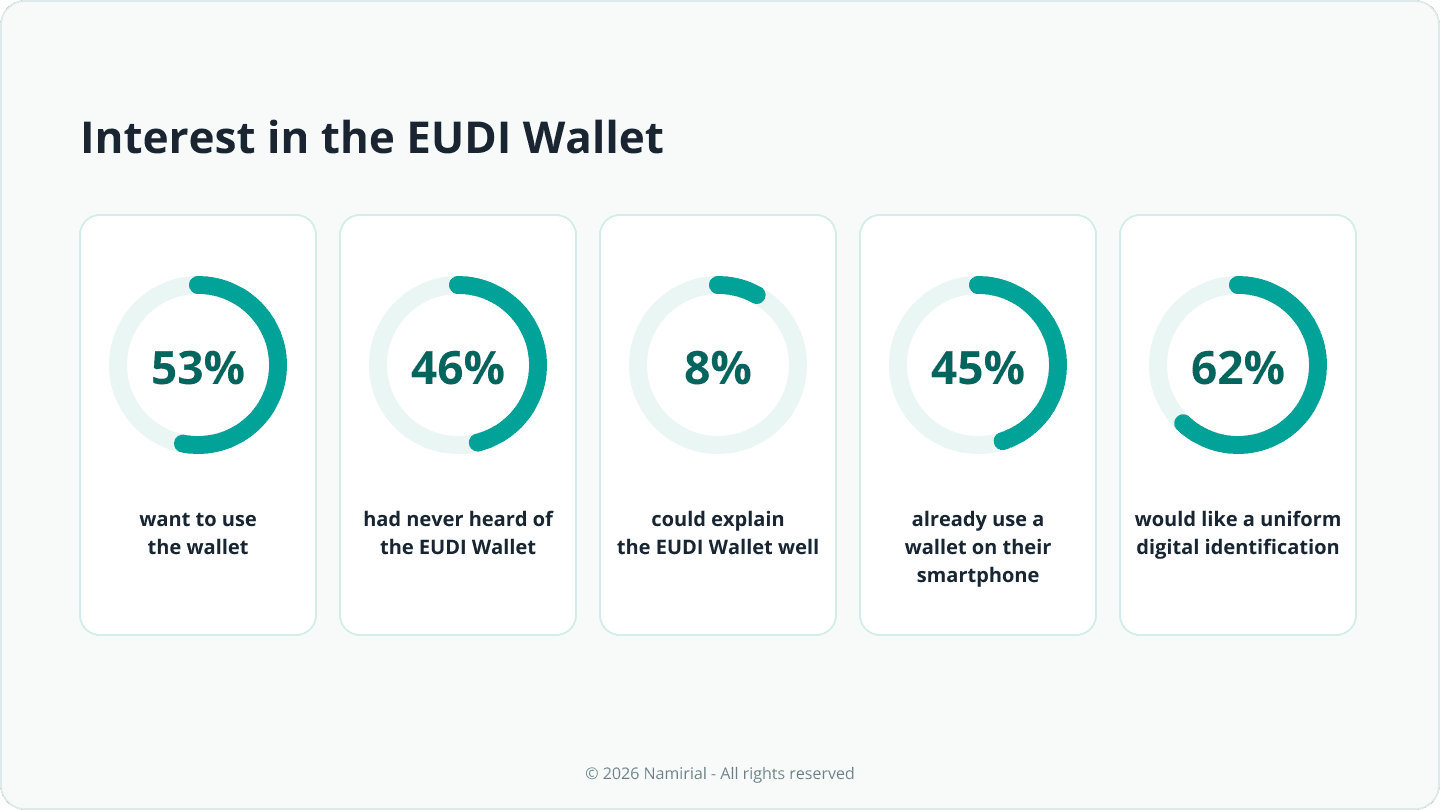
No official adoption targets have been published, and we will not forecast user numbers. The signals worth watching in the first months are more concrete: how many use cases are live in January; how smoothly PID onboarding works in practice; whether wallet-exclusive scenarios such as identification for parcel pickup or a municipal volunteer card gain traction; and when the first signature use cases appear.
What this means: The use case, not the identity, will sell the wallet. Relying parties should communicate the benefit in their own process rather than explain the technology.
6 | Orchestrator and intermediary are different jobs
Two roles are easily confused. Common Codes manages the ecosystem on behalf of the state: it governs participation, runs the hub and supports launch and growth. An intermediary under Article 5b(10) of the eIDAS Regulation acts towards the wallets on behalf of a relying party. It is treated as a relying party itself, may not store the content of the transaction, and liability for the request stays with the relying party it serves. At go-live, Germany supports direct relying-party connections; intermediaries are to follow shortly afterwards.
What this means: Namirial orchestrates the onboarding journey on behalf of the relying party, not the ecosystem. Organisations can connect directly with certificates in their own name or use Namirial as intermediary to reach all notified wallets through one integration.
7 | The role of private providers
In 2027, private providers act as relying parties, as issuers of electronic attestations of attributes and as signature providers. According to Common Codes, further providers are to bring their own wallets to market from January 2028. A qualified electronic signature directly from d-you is planned for 2027, without a confirmed quarter. Namirial is an official d-you launch partner, with a qualified electronic signature use case: identification via d-you as the basis for issuing the qualified signature certificate.
One role in the ecosystem is still unfilled: private providers of qualified electronic attestations of attributes (QEAA). Only qualified trust service providers may issue them, and under eIDAS they have the same legal effect as lawfully issued paper attestations. None of the attestations presented for launch is announced as a qualified attestation from a private provider. Where a relying party needs legal certainty – for professional qualifications, powers of representation or account ownership – qualified attestations will be required, and the ecosystem does not yet have private issuers ready to provide them.
What this means: Verification is only half the transaction. Contracts, account openings and policy changes need a legally binding declaration of intent, and the qualified signature completes what the wallet starts. As a qualified trust service provider, Namirial is preparing to add qualified attestations as the next layer.
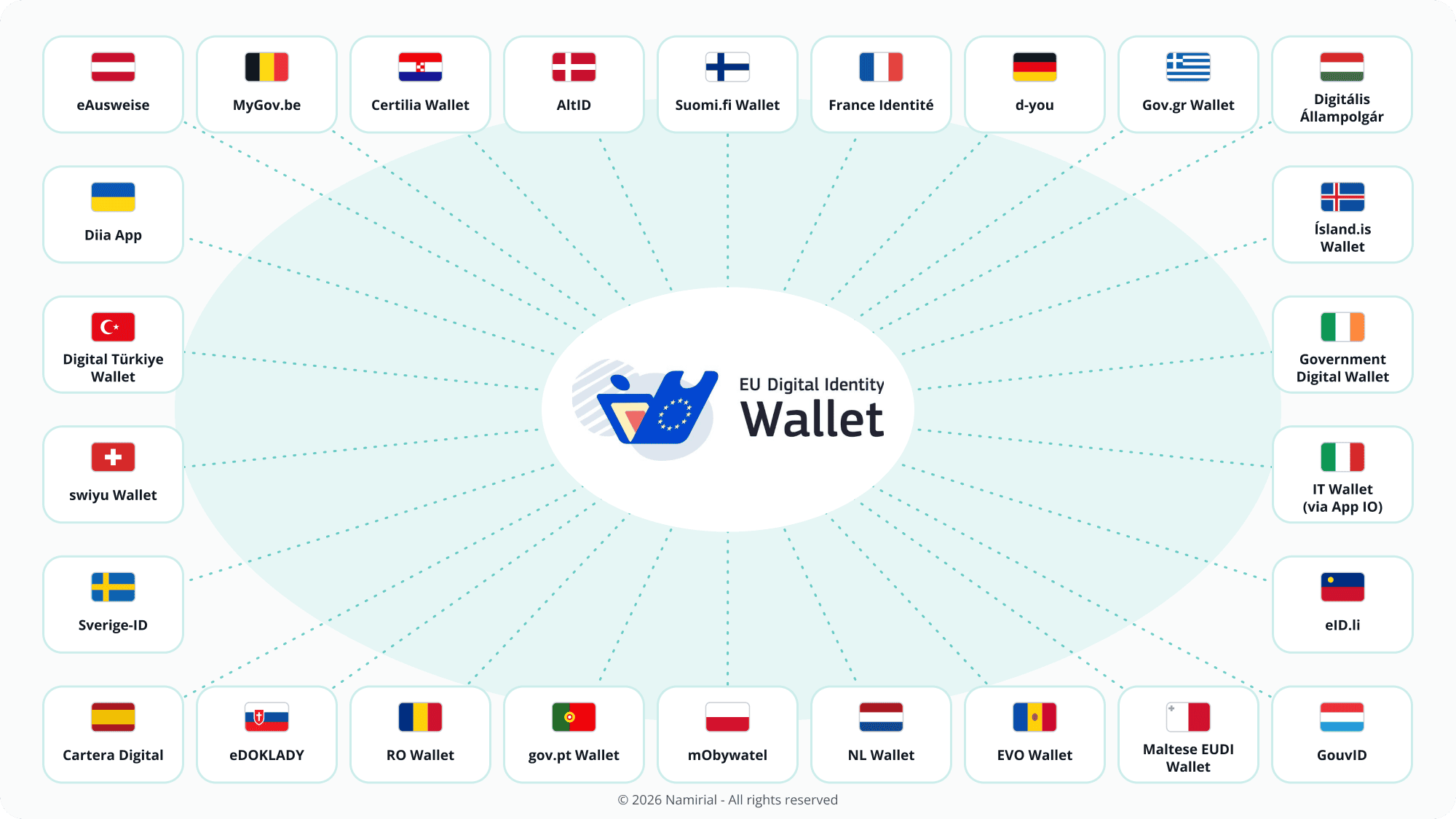
8 | d-you is one EUDI Wallet among 30+
From 24 December 2027, private relying parties that are required to use strong user authentication, including banks and payment service providers, must accept EUDI Wallets. The obligation covers all notified wallets from the EU and EEA, not only d-you. Readiness differs widely across the more than 30 national roadmaps. Namirial is the only private provider in all three roles of the Italian IT-Wallet test federation. At the France Identité interoperability event EUDI Unfold from 21 to 25 September, Namirial passed 143 of 145 test cases. Its integration in Denmark is under way. Namirial took part in the Large-Scale Pilot (LSP) POTENTIAL and in EWC. Namirial is currently engaged in both LSPs – APTITUDE and WE BUILD.
The d-you button will help the national launch: users recognise a familiar sign, and relying parties get a simple way to start. For European interoperability it is a weak foundation. A journey that offers only d-you leaves out the other notified wallets that relying parties must accept from December 2027. A wallet-neutral entry point, such as the EU Digital Identity Wallet trust mark or browser-based wallet selection, keeps the journey open to all of them. Luigi Castaldo covers the ecosystem evolution in France in his blog post “France Identité and EUDI Wallet: Namirial’s contribution to the French digital identity ecosystem”.
What this means: A relying party that plans only for d-you will have to integrate again before the end of 2027. Building for the European wallet landscape from day one avoids that second project. Use the d-you button where it helps recognition but build the journey behind it wallet-neutral.
Namirial’s perspective
Germany’s start is deliberately sequential: identity first, further attestations and signature in the course of 2027, private wallets from 2028. Namirial’s contribution is to make that sequence workable for relying parties now and portable across Europe later.
For onboarding and KYC, this means rebuilding the journey for 2027 around three principles. First, start with the process, not the interface: registration, access certificates and defined onboarding steps come before any screen design. Second, build the journey the AMLR will require: a wallet-based onboarding flow built now already serves the KYC requirements that apply from 10 July 2027, and attestations beyond identity can be added as they become available. Third, plan for the European wallet landscape from day one: because private relying parties required to use strong user authentication must accept all notified EUDI Wallets from 24 December 2027, an onboarding journey designed only for d-you would need an integration project within the year.
With Namirial Onboarding and the Namirial Wallet Platform, Namirial is ready to support relying parties in rebuilding onboarding for 2027 – from identification via wallet presentation to qualified signature, connecting directly or through Namirial as intermediary – so that an onboarding journey launched with d-you in January is ready for every notified wallet by 2027.