

What is the Digital Product Passport (DPP)?
The Digital Product Passport is part of a broader European regulatory framework aimed at making products more sustainable, transparent and circular.
The European Union is introducing a set of regulations designed to reduce the environmental impact of products, promote a more efficient use of resources and support greater circularity throughout their lifecycle. Achieving these objectives requires access to reliable information about products: which materials have been used, how they have been manufactured and what happens to them at the end of their use phase.
This need for greater supply-chain transparency and traceability has created a demand for tools capable of collecting, connecting and making this information accessible.
The Digital Product Passport (DPP) looks to fill this need. Several European regulations will progressively introduce mandatory DPP requirements for specific product categories, defining which information must be made available and according to which requirements throughout the product lifecycle. The DPP constitutes a digital representation of the product, through which information can be made available to end users and to the different stakeholders involved in the value chain. Access to data is defined according to the respective roles and rights: authorized supply-chain actors can consult the information associated with the product and, where applicable, contribute to keeping it up to date.
The information contained in the DPP may cover different aspects of the product and its lifecycle, including materials and components used, manufacturing methods and processes, product characteristics, origin, environmental performance, repairability, reuse and recyclability, as well as information relating to distribution and subsequent stages of the lifecycle. The content of the DPP varies according to the product category and the requirements established by the applicable European legislation.
The DPP therefore has a dual function: on the one hand, to make product information more accessible, structured and interoperable for supply-chain operators and, where applicable, for end consumers; on the other, to support European sustainability and circularity objectives, facilitating compliance with regulatory obligations and enabling more informed management of products throughout their lifecycle.
In this context, the DPP can also contribute to making information available to assess and reduce the environmental impact of a product, including, where required, its carbon footprint.
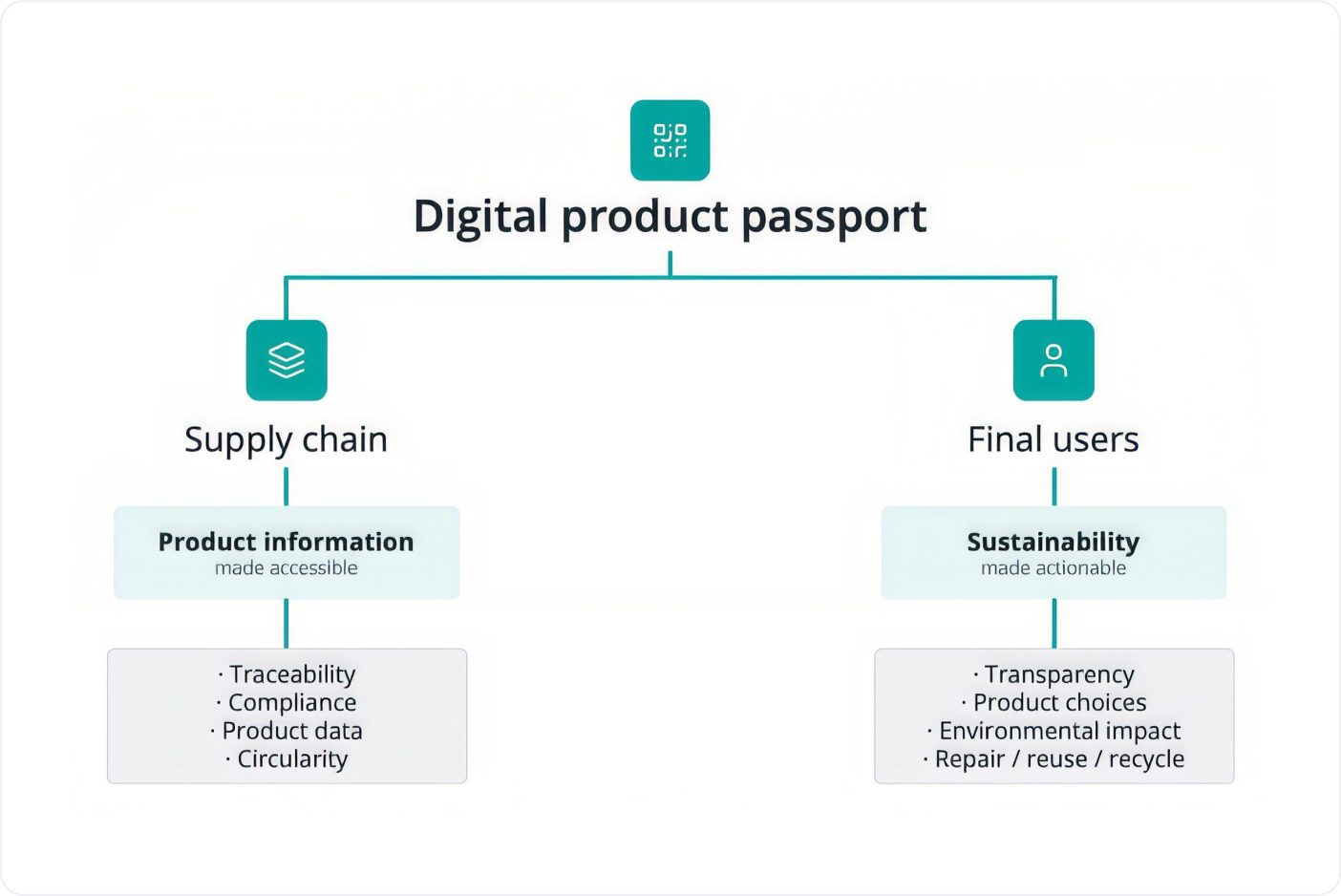
Regulatory Framework
ESPR
The regulatory framework for the DPP is established by Regulation (EU) 2024/1781 – Ecodesign for Sustainable Products Regulation (ESPR), which introduces the Digital Product Passport and establishes the general principles governing its structure, the information to be made available, access arrangements and the stakeholders involved. Specific requirements are subsequently defined for different product categories through the delegated acts provided for under the regulation.
The aspects governed by the ESPR include the structure and content of the DPP, access to information, the corresponding access rights, data interoperability and the unique identification of the product. The regulation also establishes that the DPP must be made accessible to customers through an appropriate data carrier and that the relevant information must be available before the customer is bound by a sales contract.
A key element is therefore the unique identification of the product. The regulation establishes identifiers that enable the DPP to be uniquely associated with the product, its individual unit, batch or model, depending on the level of identification required by the applicable requirements. The identifier represents the link between the physical product and its digital identity, making it possible to locate the corresponding DPP and ensure traceability throughout the supply chain.
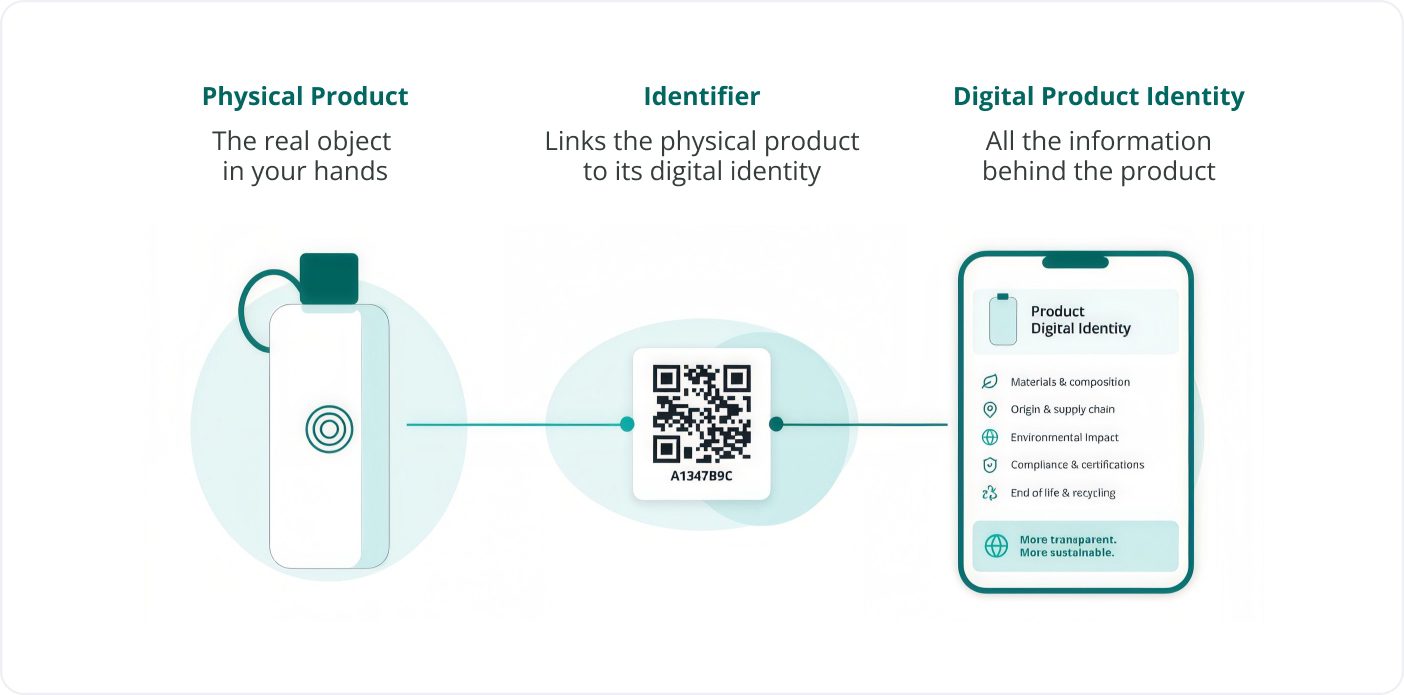
The identifiers specified in the regulation include the Global Trade Item Number (GTIN), which must comply with ISO/IEC 15459-6 or an equivalent standard and be applied to products and their component parts. The GTIN enables products to be identified with a standard already widely used across the supply chain, facilitating their recognition and the connection with the information associated with the DPP across different systems and supply-chain processes.
DPP Registry
The ESPR also provides for the establishment of a DPP Registry: a European digital registry intended to support the registration and traceability of Digital Product Passports. The regulation requires the Registry to securely store at least the unique identifiers associated with products subject to registration requirements.
The operational rules governing the Registry are established by Commission Implementing Regulation (EU) 2026/1778, which defines how products are registered and their data structured, and establishes the automated checks the Registry performs.
DPP registration takes place at the level of granularity required by the applicable legislation, which may be model, batch or item, either through the Registry interface or via API. Once the registration has been completed and validated, the system generates a unique registration identifier.
The DPP Registry does not constitute a centralized repository containing the complete content of Digital Product Passports, since the regulatory architecture is decentralized. In this sense, the Registry manages identifiers and registration-related information, while product data remains under the control of the parties responsible for the DPP and may be managed directly by economic operators or through DPP Service Providers. Where applicable, the Registry may also store a reference to the service provider hosting the DPP backup.
The Registry also supports the lifecycle management of registrations through data versioning and time validation of updates, maintaining a record of the operations performed. In this way, the system contributes to ensuring traceability and accountability of the information and activities recorded in the Registry.
The use of unique identifiers, standardized data structures and shared semantic models is therefore essential to ensuring interoperability, traceability and reliability of information, enabling different systems and supply-chain stakeholders to correctly recognize and manage product-related data.
DPP technical standards
Alongside the regulatory requirements set out in the ESPR and its implementing acts, a further layer of work has been underway to ensure that Digital Product Passports can actually function consistently once they reach the market. This is the role of the technical standards developed by CEN and CENELEC.
Commission Implementing Regulation (EU) 2026/1778 establishes the rules for verifying and authorizing actors who access the DPP Registry. CEN/CENELEC standards then translate these requirements into technical specifications covering access rights, security, data authentication, storage, archiving, and long-term data persistence. Together, these eight European standards give manufacturers, service providers and other supply-chain actors a common technical language for building and exchanging Digital Product Passports, regardless of the product category involved.
Two of these standards were recently published (16 September 2026):
- EN 18239:2026, covering access rights, security and business confidentiality, and
- EN 18246:2026, covering data authentication.
Alongside the other DPP standards already in place, they give organizations practical technical guidance for implementing DPP requirements and supporting compliance with the ESPR.
Product categories involved
The introduction of the Digital Product Passport will progressively affect different product categories and their respective supply chains. The European framework identifies a number of sectors in which information traceability, supply-chain transparency and data availability throughout the product lifecycle are particularly important.
The regulation applies initially to major product sectors, like batteries, iron and steel products, textiles and apparel, and will expand progressively as delegated acts are adopted.
Batteries represent one of the first areas in which the DPP is becoming a concrete requirement. The sector is strategic to Europe’s transition towards a more sustainable economy and to the development of low-emission mobility and energy-storage systems. At the same time, the battery supply chain involves numerous stages and a significant volume of information relating, for example, to the materials and raw materials used, manufacturing, use, repair, reuse and recycling.
In this context, the Battery Passport makes this information available throughout the battery lifecycle, promoting greater supply-chain transparency and supporting the verification of applicable sustainability requirements. The availability of structured and traceable data can also facilitate monitoring activities and contribute to steering the market towards products and processes that are more aligned with European sustainability objectives.
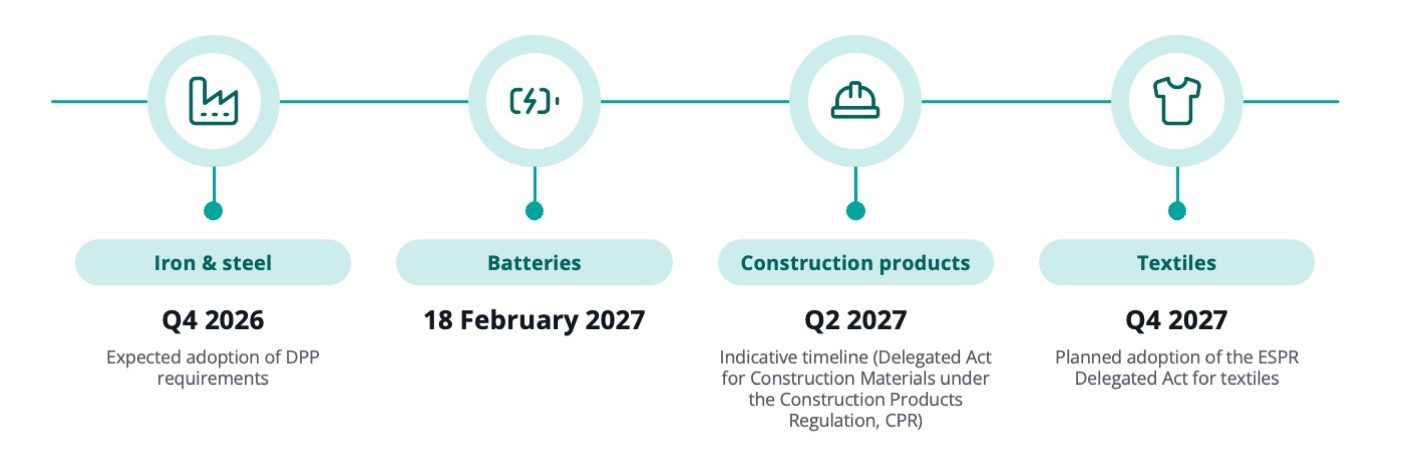
For batteries, the requirements apply in particular to electric vehicle batteries, batteries for light means of transport such as e-bikes, e-mopeds and e-scooters, batteries for domestic energy-storage systems, and industrial batteries. From 18 February 2027, all products covered by the regulation must comply with Battery Passport requirements.
A second particularly relevant area is iron & steel. Iron and steel are fundamental materials for numerous industrial sectors and underpin a wide range of products and applications, from automotive and construction to industrial equipment and machinery. Given their widespread use across European manufacturing, improving the traceability of information relating to these materials can have a significant impact on the ability to make downstream supply chains more sustainable and circular.
In this context, the DPP can help connect information relating to the product and the materials used, providing greater visibility into their origin, characteristics and management during and at the end of the product lifecycle.
Another strategic sector is textiles & apparel. The textile industry has a significant environmental impact and involves a particularly complex value chain, with numerous operators and production processes. Here too, the availability of structured information about products and their constituent materials can increase supply-chain transparency and support practices such as reuse, refurbishment and recycling.
The regulatory framework is not limited to these categories: the DPP Registry applies to any product that EU legislation requires to have a Digital Product Passport. These include products covered by delegated acts adopted under Article 4 of the ESPR, batteries covered by Regulation (EU) 2023/1542, construction products, toys, detergents and surfactants, and any other product category for which EU legislation requires a DPP and registration in the Registry.
Below is a table showing the product categories and the corresponding timeline for the entry into force of the DPP requirements for each category.
Namirial’s role
Manufacturers face a choice: build DPP infrastructure from scratch or use Namirial’s existing compliance and security framework. Namirial’s solution lets supply-chain operators generate and update passport data throughout the product lifecycle without building the entire technology infrastructure internally. Each stakeholder accesses only the data and functions their role permits: batteries manufacturer logs assembly; logistics company records shipment; retailer updates end-of-life information.
Drawing on its experience managing secure, compliant digital processes, Namirial provides manufacturers and supply-chain operators with the infrastructure to generate and manage Digital Product Passports without building it internally. This approach simplifies DPP adoption and supports operators through their transition into the new regulatory ecosystem.
Namirial’s solution enables DPP management throughout the product lifecycle, allowing authorized operators to generate and record events associated with the product and update passport information, in accordance with the roles and access rights assigned to each supply-chain stakeholder.
Another key element is DPP accessibility. Through a QR Code or another data carrier associated with the product, users can access the relevant Digital Product Passport and consult the information made available. In this way, the DPP becomes a simple and immediate access point to product information, connecting the physical and digital worlds.
For the end consumer, this means being able to scan the code associated with a product and access the available information about its lifecycle. For supply-chain operators, it means having access to an infrastructure through which relevant information can be managed and shared in a structured and traceable way.
Namirial therefore acts as a technology enabler for the new DPP ecosystem, facilitating manufacturers’ transition towards new models of product-information management and supporting the integration of the digital processes required to meet regulatory obligations.
Namirial identity provider
The introduction of the DPP Registry adds another important dimension to the DPP ecosystem: the trusted digital identification of the organizations and individuals interacting with the Registry.
To access and operate within the DPP Registry, economic operators and other relevant actors must undergo a verification process based on recognized digital identification and trust mechanisms. Depending on the type of actor, these mechanisms may include qualified electronic signatures, qualified electronic seals, electronic identification (meeting the eIDAS assurance level “high”), and qualified electronic attestations of attributes (also called virtual credentials).
This requirement creates a direct connection between the DPP ecosystem and the world of digital identity and trust services. Operators need to be reliably identified before they can access the Registry and perform the operations associated with their role in the product value chain.
As a provider of qualified trust services and digital identity solutions, Namirial can support organizations in establishing their trusted digital identity and accessing the identification and authentication mechanisms required to interact with the DPP ecosystem.
In this sense, Namirial can act as an Identity Provider, enabling organizations and authorized users to securely establish their identity and use trusted credentials when interacting with the DPP Registry and related services.
Food Metaverse: an operational DPP project
Namirial has already gained hands-on experience in the field of Digital Product Passports through its participation in the Food Metaverse project, an active, production-ready solution that applies the DPP model to the agri-food supply chain.
The Food Metaverse project is based on an evolving vision of the agri-food supply chain, where advanced technologies enable processes, data, certifications and quality information to be integrated throughout the entire journey, from field to table. The project also leverages agritech infrastructures developed from activities initiated by the University of Turin, together with smart sensors installed directly in the field. These technologies make it possible to collect and interpret signals from different ecosystems, transforming natural phenomena into data that can be used to understand environmental conditions and document the different stages of production.
The objective is to create a structured information layer that makes it possible to track and document the different stages in the lifecycle of an agri-food product, from cultivation to market placement and access to information by the end consumer. In this way, the Food Metaverse Platform contributes to increasing supply-chain transparency, enhancing local production, and supporting the transition towards more sustainable and traceable production models.
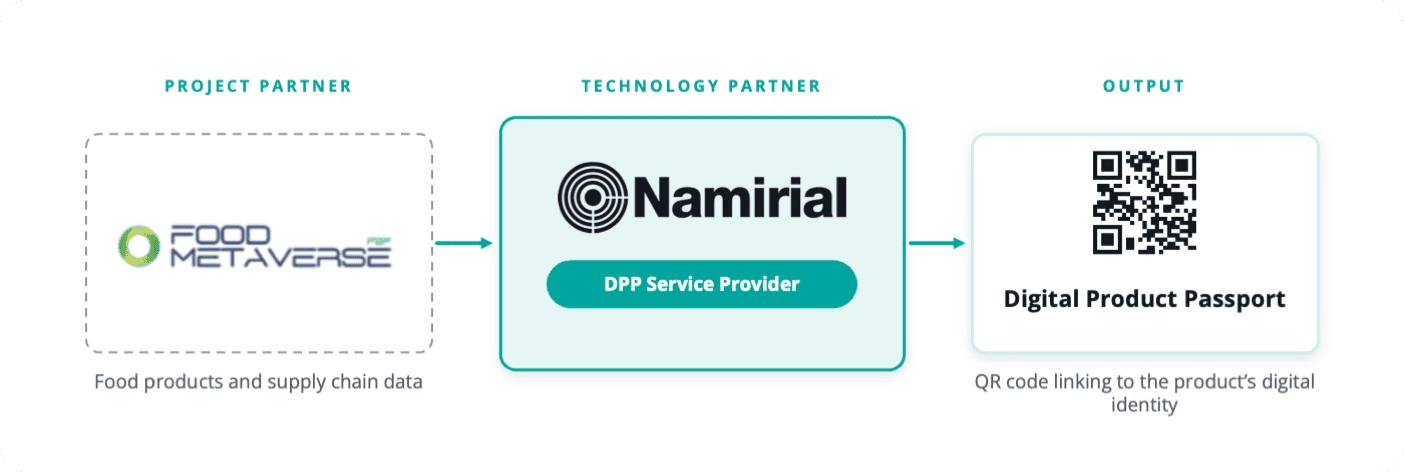
Within the project, Namirial operates as a DPP Service Provider, providing the infrastructure required for the issuance and management of Digital Product Passports for agri-food products.
The solution enables the different stages a product goes through along the supply chain to be tracked, from production to the end consumer, creating a digital foundation for collecting, managing and sharing the information associated with the product. In this project, Namirial acts as a trusted technology partner, providing the infrastructure and technological capabilities required to enable authorized users to generate and manage Digital Product Passports.
The project is currently active and in production, with a solution already operational for the generation and management of Digital Product Passports.
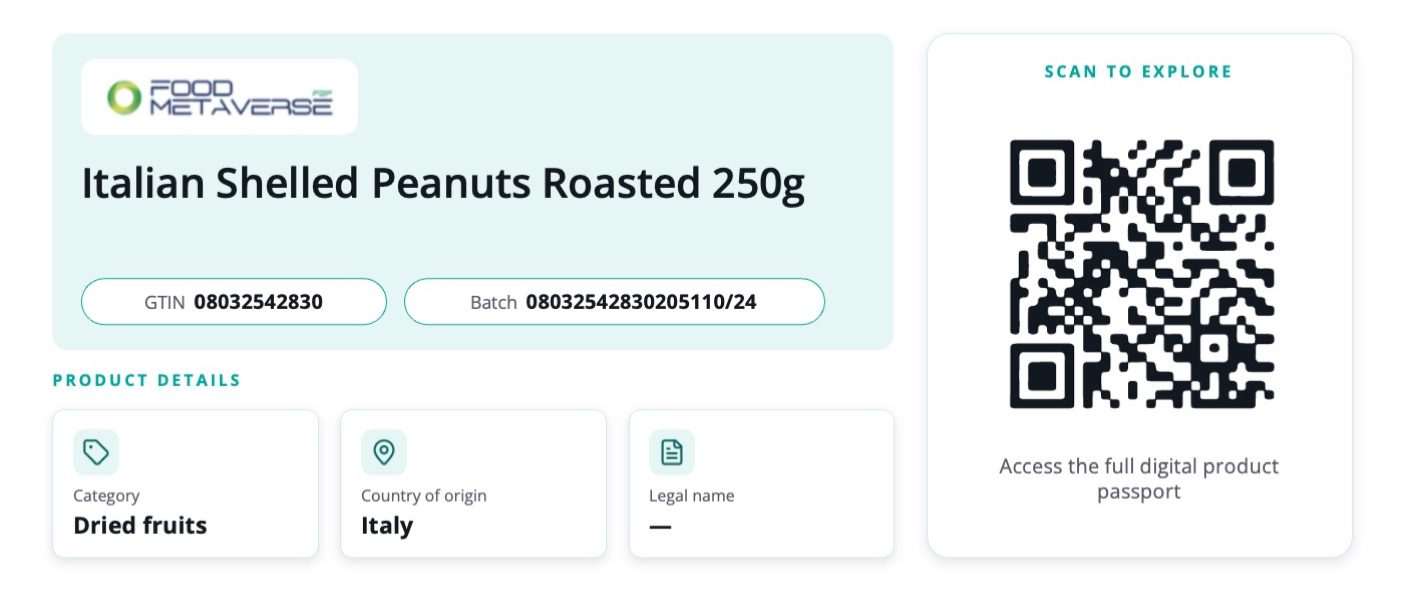
Below is a specific example in which scanning the QR code on the product allows users to access and view all relevant product information.
What’s next
The Digital Product Passport should be considered within a broader and increasingly rapid transition towards the digitalization of identities and information. From the digital identity of individuals and organizations to the digital identity and traceability of products, the European Commission is progressively establishing the foundations for a more digitally interconnected environment.
With the implementation of the ESPR Regulation and the progressive introduction of DPP requirements across different product sectors, this transition is becoming increasingly tangible. The development of the DPP Registry, together with the emergence of common technical standards, represents a further step towards a more standardized and interoperable digital ecosystem.
For organizations, the next step is therefore not only to comply with individual regulatory deadlines, but to prepare for this broader shift in the way products are identified, documented and managed throughout their lifecycle. Those that start addressing these changes early will be better positioned to adapt to the evolving regulatory and digital environment, rather than having to respond to it once the transition is already underway.