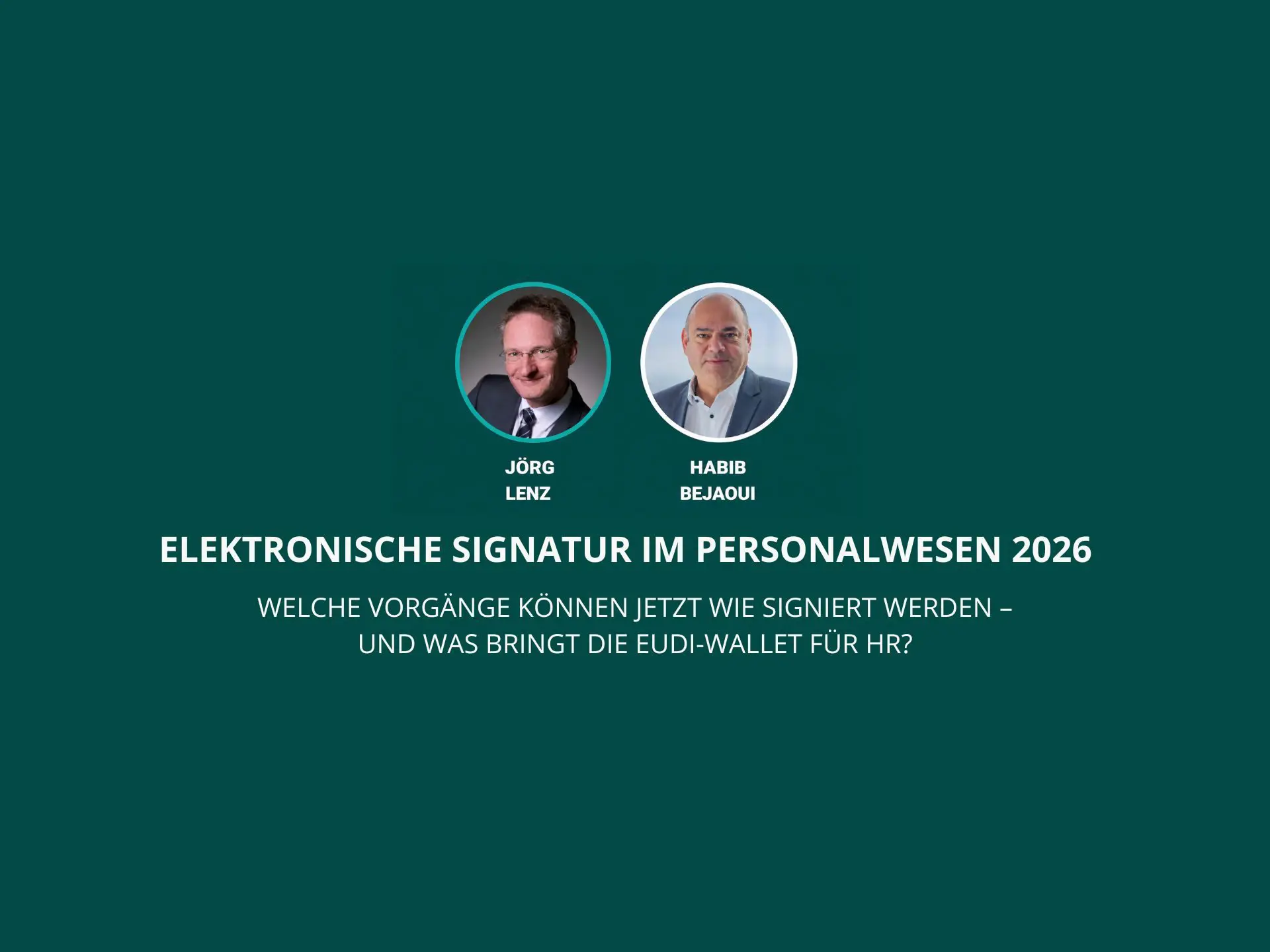
Which HR processes can currently be legally handled electronically – and which cannot? How do simple, advanced, and qualified electronic signatures differ in evidentiary value? And what will the EUDI Wallet concretely bring to HR?
This webinar, hosted by Namirial on June 30, 2026 as part of the Namirial Sommerakademie, gives professionals and executives in HR, Compliance, Legal, and IT a practical overview of the current state of formal requirements – and what companies should prepare now for the EUDI Wallet.
The event was moderated by Jörg Lenz, Director of Marketing & Communications at Namirial. Habib Bejaoui, Head of Sales Germany at Namirial Deutschland GmbH, brought insights from numerous HR digitalization projects and covered the topics from a strongly practice-oriented perspective.
Context
Thanks to a series of legislative changes, there are now more opportunities to make HR processes more efficient and cost-effective: temporary employment contracts and proof of essential working conditions can in many cases be handled in text form. For certain processes – including fixed-term employment contracts, employment references, and non-compete clauses – written form is still required.
At the same time, leading employment lawyers warn against equating text form with evidentiary certainty: email, SMS, or messenger messages meet the legal requirement, but do not establish prima facie evidence in a dispute. Anyone introducing digital HR processes therefore needs to know not only the formal requirements, but also which type of signature carries which evidentiary value and how legally verifiable delivery works.
Key topics of the webinar
- Overview of HR formal requirements (as of June 2026) – What is written form, what is text form, what is paper form? Which processes can be handled electronically – and which cannot?
- Changes already in force – What applies now, and what has changed compared to before?
- Processes requiring QES – Fixed-term employment contracts, employment references, non-compete clauses, and other exceptions in detail.
- Evidentiary value and assessment of evidence – Differences between SES, AES, and QES: what really counts in a dispute?
- Proof of delivery for text-form documents – Why an email alone does not establish prima facie evidence, and how legally verifiable delivery works.
- Choosing the right signature provider – What matters, and why comprehensive digitalization is only possible with providers that support all signature types.
- Practical examples from HR – End-to-end processes, system integration, and efficiency gains from Namirial customer projects.
- What the EUDI Wallet will bring for HR – Timeline, concrete use cases in HR, and what companies should prepare now.
- Open political issues – Where the federal government still needs to act for digital HR processes – and when this might realistically happen.
The webinar was held in German and is part of the Namirial Sommerakademie 2026.
Enter the password to access the recording.
If you don’t know the password, please fill out the form below to receive it by email.