
Fragmented compliance costs too much, and no longer offers adequate protection
60% of organizations still manage their compliance risks in a fragmented way: an e-signature tool here, a KYC solution there, an archiving system somewhere else, and legal, IT, and business teams that do not speak the same language. This model is now obsolete.
The reason is straightforward: compliance has become too complex, too cross-functional, and too strategic to be managed in silos. eIDAS 2.0, DORA, the AI Act, the AMLR; these frameworks do not affect a single department. They affect every digital process, from client onboarding to the retention of legal evidence. Organizations that have yet to make this shift find themselves chasing obligations and paying disproportionate remediation costs.
There is a structured, context-adapted alternative: the Compliance Intelligence model.
Namirial: architect of Compliance Intelligence in Europe. As a Qualified Trust Service Provider (QTSP) under European law, Namirial offers a unified platform that natively integrates identity verification, document control, electronic signature, certified archiving, and continuous risk monitoring. A coherent architecture, audited against eIDAS standards and ISO 27001 certified, deployed in more than 90 countries.
What is Compliance Intelligence?
Compliance Intelligence refers to the integration, within a unified technology architecture, of all the capabilities required for digital trust: identity verification, document control, electronic signature, certified archiving, a trust index, and continuous regulatory monitoring.
This is not a simple aggregation of tools. It is about having a coherent architecture that covers the entire lifecycle of a digital transaction: from the identification of the stakeholder through to the proof of the decision taken, including the collection and control of documents, while continuously generating the evidence required for auditability.
When structured in this way, compliance protects organizations against three major categories of risk: geopolitical, regulatory, and technological. These are the three shields of the Compliance Intelligence model.
First shield: geopolitical
Choosing your provider means choosing your jurisdiction
In a context of globalization and fragmentation of technology ecosystems, the choice of trust service provider has become a geopolitical issue. The US CLOUD Act of 2018 is a clear illustration: it allows American authorities to access data held by any company under their jurisdiction, regardless of where that data is stored. For organizations handling sensitive data (identities, signatures, legal evidence) this risk is far from theoretical.
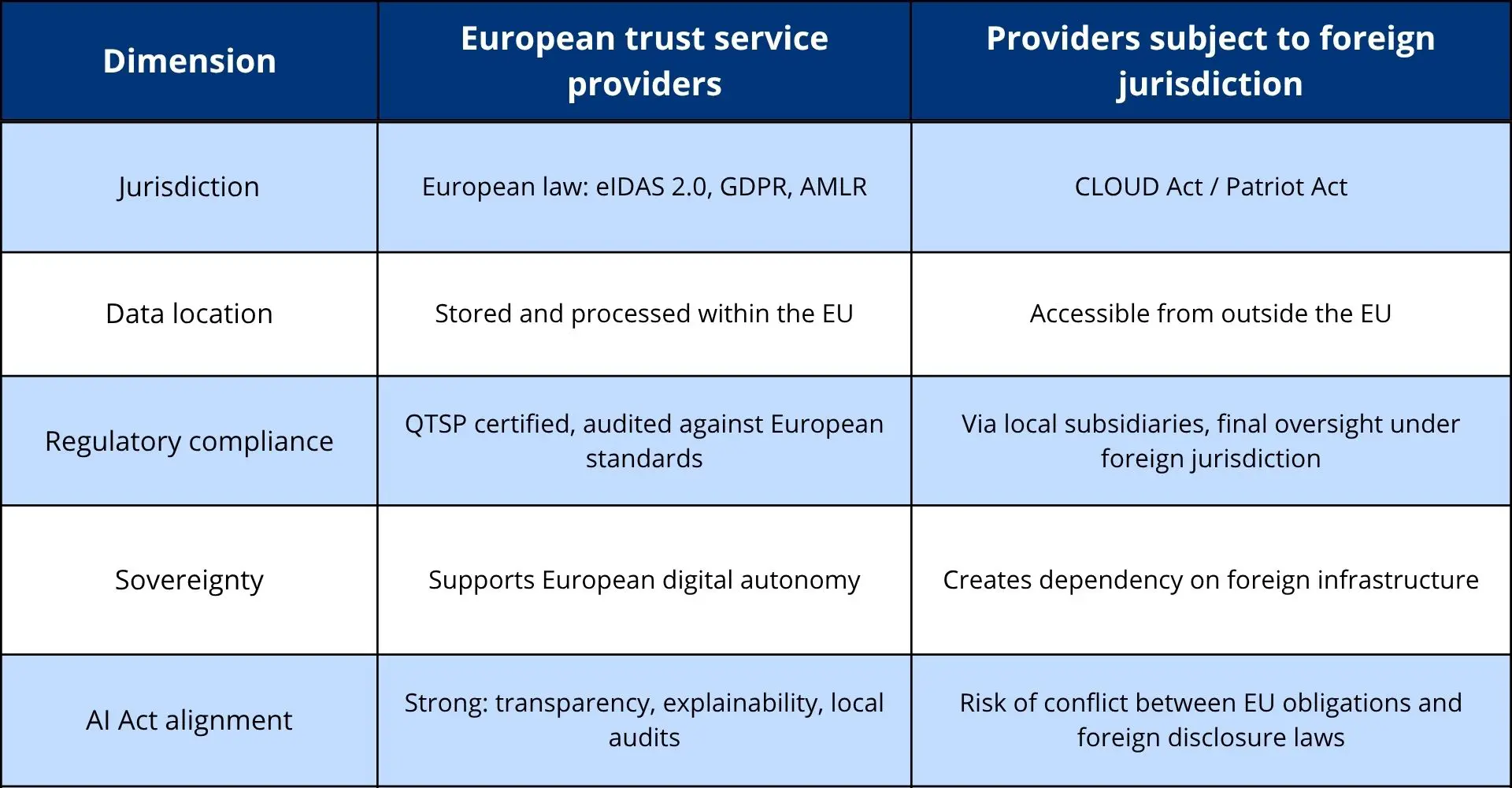
By choosing a provider certified under European law, organizations secure three essential guarantees: the protection of sensitive data, GDPR compliance, and independence from external critical infrastructure. Digital sovereignty ceases to be a political debate: it becomes a strategic decision criterion and a concrete competitive advantage in procurement processes and international partnerships. This distinction is especially concrete when comparing European QTSPs with US-incorporated providers. Subject to the CLOUD Act, and without their own qualified certification authority directly listed on the EU Trusted List, some of our American competitors must rely on third-party QTSPs to deliver Qualified Electronic Signatures.
For organizations building the digital trust infrastructure now required by eIDAS 2.0, DORA, and the AI Act, that means depending on a fragmented, externally-delegated trust chain rather than a single sovereign provider.
Namirial: digital sovereignty by design. As a QTSP certified under eIDAS and ISO 27001, Namirial ensures that all sensitive data related to identity and signatures remains under European jurisdiction. Our infrastructure is in Europe, protecting clients from the risks posed by extraterritorial legislation such as the U.S. CLOUD Act. As Max Pellegrini, CEO of Namirial, notes: “Completing the European single market could generate up to €1 trillion in additional growth over the next decade. Organizations that embrace integrated digital trust today will be best positioned to capture that opportunity.”
Second shield: regulatory
Anticipating obligations rather than reacting to them
The European regulatory landscape is undergoing a profound transformation. eIDAS 2.0, the AI Act, DORA, the AMLR: each framework introduces new requirements, with overlapping timelines and expanding scopes. Organizations that approach these changes reactively find themselves running compliance projects under pressure, with all the costs and operational risks that entails.
Conversely, organizations with a Compliance Intelligence architecture absorb new obligations without operational disruption. By automating control, traceability, and auditability mechanisms, they reduce the cost of late remediation and strengthen their credibility with regulators, clients, and partners.
This shield is particularly strategic in heavily regulated sectors: financial services, insurance, healthcare, energy, and telecoms; where demonstrating compliance has become a decisive criterion in supplier selection.
“By placing trust and accountability at the heart of a safe and predictable digital ecosystem, the European Union is not merely legislating for convenience: it is implementing its core values in a secure digital ecosystem.”
— Andrea Servida, founding father of eIDAS
Namirial’s regulatory approach: anticipate, don’t react. Namirial continuously monitors the evolution of the European regulatory framework and integrates every update into its solutions ahead of mandatory deadlines. Clients benefit from compliance that is maintained at all times, without having to launch a dedicated project for every new obligation. From DORA to the AMLR, from the AI Act to eIDAS 2.0: Namirial’s architecture absorbs regulatory change by design.
Third shield: technological
Governing AI and anticipating emerging risks
The rise of artificial intelligence creates new operational risks that compliance must anticipate.
The AI Act requires organizations to implement governance and oversight mechanisms for high-risk AI systems. Identity verification technologies, risk scoring engines, and document analysis tools are directly in scope: they must meet requirements for algorithmic transparency, human oversight, bias monitoring, and complete traceability.
DORA simultaneously reinforces digital operational resilience requirements: identification of technology dependencies, infrastructure robustness testing, and business continuity mechanisms. Both regulations converge on the same demand: organizations must be able to demonstrate, at any time, that their systems are governed, resilient, and compliant.
Looking further ahead, post-quantum cryptography represents an emerging risk that very few organizations are yet anticipating. The cryptographic mechanisms that currently secure qualified electronic signatures and sensitive data could be undermined by advances in quantum computing. Organizations that integrate this dimension into their technology roadmap today will avoid a costly disruption in the future.
Namirial: responsible AI and resilience by design. Namirial guarantees >99% infrastructure availability through redundant architectures and automated failover. Every AI model deployed is transparent, auditable, and aligned with AI Act and GDPR requirements. Our teams are already incorporating post-quantum cryptography considerations into the product roadmap, anticipating disruptions before they become urgent issues for our clients.
The measurable benefits of Compliance Intelligence
Secure onboarding in under 60 seconds
By orchestrating remote identity verification, automated document control, qualified electronic signature, and legal archiving into a single journey, organizations can complete a full, secure, and compliant client onboarding in a matter of minutes. In 2026, onboarding in under 60 seconds is becoming the new reference standard, in both B2C and B2B contexts.
Continuous risk detection
Rather than relying on a single check at onboarding, organizations adopt continuous, automated monitoring. This shift to permanent surveillance reduces exposure to undetected fraud and its associated costs: direct financial losses and the risk of regulatory sanctions.
A significant reduction in time-to-revenue
By streamlining controls and reducing manual validations, organizations shorten the time between client onboarding and the first digital transaction. This is a meaningful economic advantage in sectors such as financial services, insurance, logistics, and real estate.
A decisive competitive advantage in sensitive sectors
In sectors where compliance is a selection criterion (public sector, financial services, healthcare, defense) an organization with a mature Compliance Intelligence can respond faster, more precisely, and with documented evidence that less structured competitors simply cannot produce.
Concrete results with Namirial. Our financial clients have reduced their onboarding processing time from weeks to seconds. Our solutions automatically detect expired documents, and enable processing of up to five times more cases in the same timeframe. Our insurance clients convert more clients with a 100% online onboarding process, accessible from any device.
Compliance Intelligence: an operational reality
Compliance Intelligence is not a theoretical vision. It is deployed today in more than 90 countries, across sectors as diverse as banking, insurance, real estate, HR, and the public sector. The organizations that have adopted it have not merely solved a compliance problem: they have transformed a cost center into a lever for performance and differentiation.
“Organizations that embed compliance from the design stage of their business processes gain in efficiency and agility, reduce their compliance costs, and strengthen trust with their partners, clients, and regulators. They anticipate regulatory change where their competitors are left scrambling to react.”
— Pierre Feligioni, Deputy CEO, Namirial
DOWNLOAD THE WHITE PAPER FOR FREE
To understand the foundations of this approach and assess your organization’s maturity level, DOWNLOAD THE WHITE PAPER FOR FREE “Building the Future of Digital Trust in Europe” and explore Namirial’s Compliance Maturity Framework.