
Is your organization ready for the regulatory wave of 2026 and beyond?
In just two years, the European regulatory landscape has undergone an unprecedented transformation. GDPR, eIDAS 2.0, DORA, NIS2, the AI Act, the AMLR; these frameworks are fundamentally reshaping what compliance means for organizations in 2026 and the years ahead.
Timelines overlap, obligations multiply, and the impact now spans multiple functions across the enterprise.
Faced with this regulatory inflation, decision-makers often find themselves in the same position: they know they must comply, but struggle to identify what is urgent, what can wait, and, above all, what it concretely requires of their organization. This is not a question of competence. It is a question of volume and complexity.
This article aims to decode current and upcoming regulations. For each key framework: a clear explanation, a timeline, and a concrete business impact.
Regulatory compliance is now a boardroom agenda item.
Two years of regulatory acceleration, and it is only just beginning
To grasp the scale of this shift, context is essential. The European Union has made a deliberate choice to regulate strongly in order to protect its digital sovereignty. These frameworks are not merely designed to govern technology: they aim to build a genuine digital trust infrastructure across Europe, grounded in data protection, secure digital transactions, interoperability of services, and the resilience of critical infrastructure.
The result is a regulatory acceleration that is forcing organizations to transform their processes, their governance, and their operating models. Those that still treat compliance as a one-off or reactive project, managed in silos between legal, IT, and business teams, are falling structurally behind. And that gap has a real cost: according to the Ponemon Institute, non-compliance costs on average 2.71 times more than compliance: $14.82 million versus $5.47 million per year.
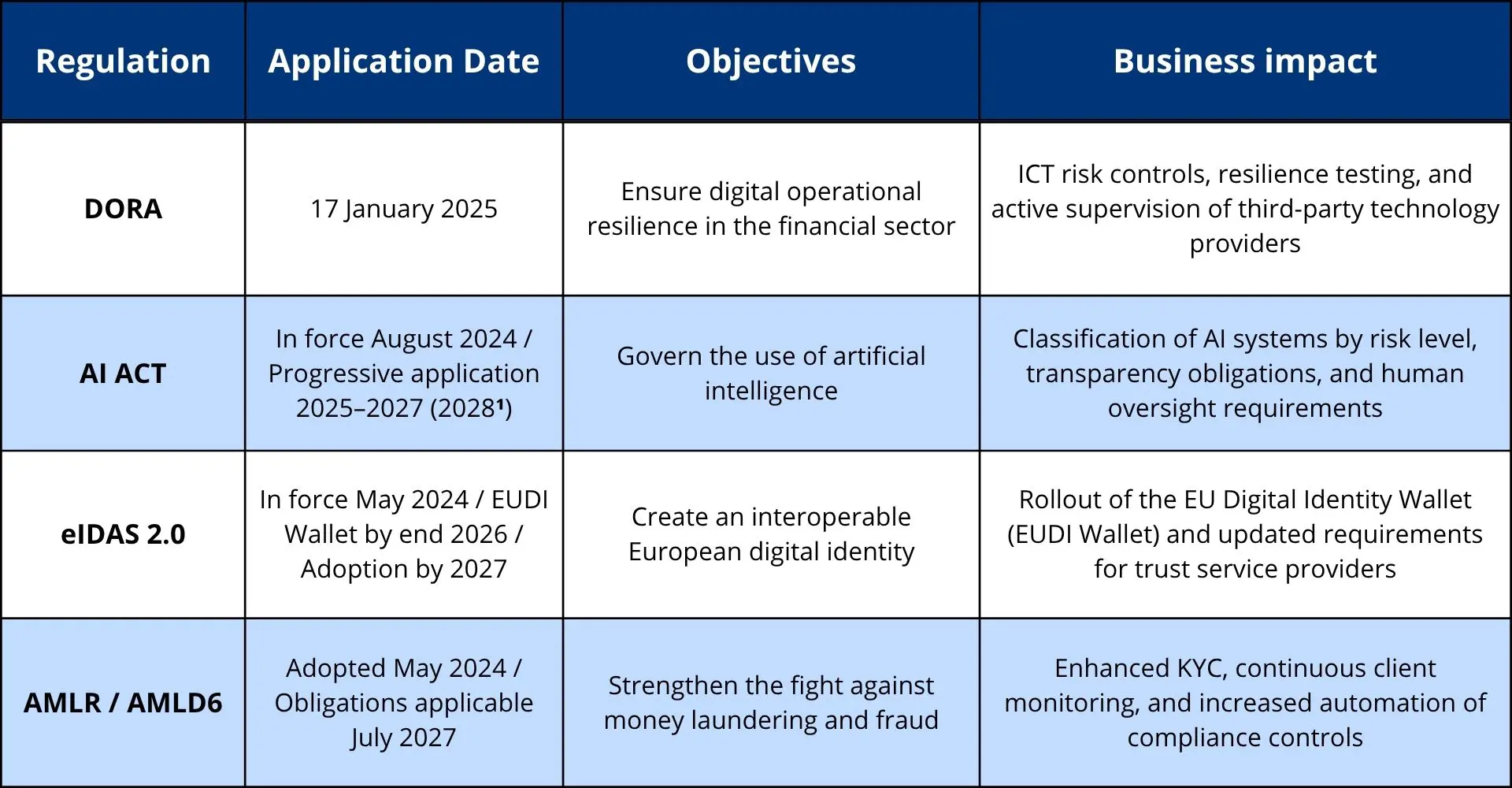
Here are the four frameworks structuring European organizations’ obligations through 2027 and beyond:
What each regulation changes for organizations
eIDAS 2.0: towards an interoperable European digital identity
eIDAS 2.0 is far more than a technical update. It establishes a new architecture for digital trust across Europe, with the EU Digital Identity Wallet (EUDI Wallet) at its center – to be deployed across all member states by end 2026 and adopted by regulated entities by 2027 for strong user authentications.
For businesses, this means new requirements for trust services and compliant electronic signature providers. Only Qualified Trust Service Providers (QTSPs), certified under European law and audited against eIDAS standards, can guarantee the full legal validity of digital signatures and the evidence they produce. This is no longer optional: it is a prerequisite for operating in the market. Providers such as DocuSign or Adobe can deliver QES mainly by relying on third-party QTSPs. For organizations in regulated sectors, this dependence on an external trust chain introduces additional complexity and a layer of accountability that sits outside their primary provider relationship.
The impact extends well beyond signing. eIDAS 2.0 redefines the requirements for identity verification and digital customer journeys. Organizations will need to accept and verify digitally certified identities at European scale, making onboarding processes more reliable, faster, and fully interoperable across member states. For organizations operating across multiple European markets, this represents a major structural shift — one that can standardize customer journeys, automate document checks, and secure client onboarding without added friction.
Namirial: a reference partner for the transition to eIDAS 2.0. As a Qualified Trust Service Provider (QTSP) under European law, Namirial supports its clients in adopting the new eIDAS 2.0 requirements: qualified signatures, electronic seals, certified timestamping, and remote identity verification. Our solutions are interoperable with European identity systems and natively designed to integrate with the EUDI Wallet. Because compliance should be an experience accelerator, not a barrier.
DORA: digital operational resilience becomes a legal obligation
Applicable from 17 January 2025, DORA (Digital Operational Resilience Act) directly affects the financial sector: credit institutions, investment firms, insurance companies, pension funds, and the ICT providers that support their critical functions. Its purpose is clear: to ensure that financial organizations can sustain critical operations in the event of ICT disruptions, whether internal or third-party in origin.
In practice, DORA mandates stronger ICT risk controls, regular resilience testing, and active management of third-party technology providers. Senior management bears personal liability for failures. This is no longer an IT matter: it is a governance issue at the highest level.
Namirial’s solutions built for DORA. Namirial guarantees >99% infrastructure availability through redundant architectures, automated failover, and proactive monitoring. Our organization meets DORA’s 24-hour incident notification requirements, with premium-level support and resolution commitment. As an ISO 27001-certified QTSP, Namirial provides financial clients with complete traceability, tamper-proof legal archives, and full data reversibility, all essential elements for meeting the third-party risk management requirements of DORA’s Article 30.
The AI Act: govern AI or accept the exposure
The AI Act entered into force in August 2024, with progressive application through 2027 and maybe 2028. Its founding principle: classify AI systems by risk level. What many organizations still overlook is that identity verification technologies, risk scoring engines, and document analysis tools are directly in scope. Classified as high-risk, they must meet four non-negotiable requirements:
- Algorithmic transparency: decisions must be explainable and documented
- Human oversight: human control is required for any high-risk automated decision
- Bias monitoring: algorithms must be audited to prevent discriminatory outcomes
- Full traceability: data, models, and decisions must remain permanently auditable
Responsible AI, according to Namirial. Namirial embeds AI at every stage of the digital transaction lifecycle: intelligent identity verification (liveness detection, biometric analysis), document fraud controls, KYC risk scoring. In line with the principles of the AI Act and GDPR, our models are transparent, auditable, and designed to augment – not replace – human judgement. Every automated decision remains explainable and traceable.
AMLR / AMLD6: KYC gets stronger and more automated
Adopted in May 2024 and applicable from July 2027, the new anti-money laundering regulation impose enhanced KYC, including the usage of eIDAS services provided by Qualified Trust Service Providers, eIDs and the European Digital Identity Wallets, continuous client monitoring throughout the relationship, and increased automation of controls. The deadline may seem distant, but organizations that have not yet started their compliance journey are already accumulating a gap that will be difficult to close.
KYC with Namirial. Namirial supports organizations in the new compliant-KYC processes: with multiple identification methods, client risk profiles, automatic updating of risk assessments, and real-time compliance alerts. Our identity verification solution covers documents from over 200 countries using AI, integrate more than 25 eIDs and it’s already able to accepted the upcoming European Digital Identity Wallets. From initial onboarding to ongoing surveillance, Namirial automates the entire AML compliance cycle.
Compliance: a boardroom agenda item
Compliance is no longer a support function confined to the legal or IT department. It has become a strategic priority at the highest level of the organization, for three fundamental reasons.
First: growing personal liability for executives. Several frameworks, including NIS2, DORA, and the AI Act, directly reinforce the personal accountability of governing bodies in the event of failure. This is no longer abstract, collective responsibility: it is personal exposure for senior leaders.
Second: a direct impact on the business model. Access to the European market now depends on the ability to demonstrate compliance. In highly regulated sectors, financial services, insurance, healthcare, energy, telecoms, compliance has become a decisive criterion in the selection of suppliers and partners.
Third: systemic risk from non-compliance. Financial sanctions, reputational damage, and operational disruptions can have a lasting impact on the organization and its financial performance.
The question organizations must ask themselves today is: “Are we structured to embed compliance as a lever for performance and resilience?”
Two postures in the face of regulatory acceleration
Given this context, organizations face a clear strategic choice: one with very concrete consequences for their competitiveness over the medium term.
The reactive posture: treating compliance on a case-by-case basis, viewing it as a cost center, managing it in silos. This approach typically results in missed regulatory deadlines, remediation projects launched under pressure, high costs, and significant operational risk.
Compliance by Design: embedding compliance from the outset into business processes, IT architectures, and customer journeys, rather than bolting it on afterwards. Organizations that adopt this approach improve efficiency, reduce compliance costs, and strengthen trust with partners, clients, and regulators. They anticipate where their competitors merely react.
This is not a theoretical distinction. According to several sector analyses, institutions that adopt RegTech automation can reduce their operational compliance costs by 20 to 40% (LexisNexis Risk Solutions, True Cost of Financial Crime Compliance Report 2023).
Namirial: a Compliance by Design partner. Our modular, API-first architecture enables organizations to connect their identity, signature, document management, and compliance processes with minimal friction. By embedding European sovereignty, transparency, and automation into every workflow, Namirial turns compliance into a catalyst for innovation: not a constraint. Completing the European single market could generate up to €1 trillion in additional growth over the next decade. Organizations that embrace integrated digital trust today will be best positioned to capture that opportunity.
The 3 mistakes to avoid when preparing for regulatory change
1. Treating each regulation in isolation. This is the most common, and most costly, reflex. An eIDAS project owned by IT, a DORA workstream led by the CISO, an AI Act workstream managed by Legal: the result is an accumulation of redundancies, blind spots, and a final bill far higher than an integrated approach would have required. These frameworks share the same core requirements: traceability, auditability, sovereignty, and deserve to be addressed coherently.
2. Waiting for an enforcement notice. Organizations that launch compliance projects under the pressure of an audit or regulatory notification pay several times over: high remediation costs, significant operational risks, and damaged credibility with supervisors. Anticipation is a strategic necessity.
3. Entrusting data to a provider outside European jurisdiction. The US CLOUD Act of 2018 allows American authorities to access data held by companies under their jurisdiction, regardless of where that data is stored. In a context where eIDAS 2.0 and GDPR are reinforcing sovereignty requirements, working with a provider not certified under European law represents a significant regulatory and geopolitical risk. This is not an abstract concern: providers such as DocuSign are incorporated under US law and subject to the CLOUD Act, meaning that sensitive identity data and signed documents processed through their platforms can be accessed by US authorities — regardless of where those files are physically stored. As eIDAS 2.0 raises the bar for legal validity, organizations should ask whether their provider controls the full trust chain — or delegates it.
Namirial: a QTSP under European jurisdiction. As a Qualified Trust Service Provider audited against eIDAS standards and certified ISO 27001, Namirial ensures that sensitive identity and signature-related data remains under European jurisdiction. Our infrastructure is European by design, protecting clients from the risks posed by extraterritorial legislation such as the U.S. CLOUD Act.
In conclusion: where does your organization stand?
The real question decision-makers must ask today is not “are we compliant?” but “are we structured to absorb the regulatory inflation that is already under way?”
European organizations have an advantage that many still underestimate. The European regulatory framework is not an administrative burden: it is a powerful standard for digital trust, increasingly recognized as a decisive selection criterion in international commercial relationships. Organizations that treat it as a strategic asset, rather than a cost center, build a structural, lasting competitive edge.
Namirial: your digital trust partner for 2026 and beyond.
As a certified QTSP and a leading provider of Digital Transaction Management (DTM) in Europe, Namirial supports organizations in meeting their regulatory obligations: eIDAS 2.0, DORA, the AI Act, AMLR. Our solutions cover the full lifecycle of digital transactions, from identity verification to legal archiving, so that compliance becomes an accelerator of responsible growth.
To go further, download the whitepaper “Building the Future of Digital Trust” and assess your organization’s maturity level using the Compliance Maturity Framework.