
The rise of the agentic enterprise
Something fundamental is shifting in how businesses operate. AI agents are no longer experimental side projects, they are becoming the primary interface between organizations, customers, and services.
In onboarding alone, agents are beginning to orchestrate end-to-end journeys: verifying identities, extracting and validating documents, checking solvency, triggering signatures. What once required weeks of manual processing, multiple vendors, and expensive native connectors is collapsing into a single conversational flow.
But here is the uncomfortable truth: most of this is happening without a trust infrastructure.
Automation without trust is fragile
Organizations that focus only on speed are building on sand. The patterns are familiar: fragile processes, audit gaps, and growing customer distrust.
Recent data paints a stark picture:
- 77% of companies using AI in production have experienced at least one security incident.
- The average cost of a data breach has reached $4.88 million.
- These numbers will only grow as agents take on more autonomous decision-making.
The problem is not the agents themselves. The problem is that agents are operating in a world designed for humans, where trust was implicit in the person sitting behind the screen.
When an AI agent initiates a transaction:
- Who is accountable?
- How do you verify the agent is authorized to act?
- Where is the audit trail?
These are not theoretical questions. They are operational gaps that regulators, compliance teams, and customers are already asking about.
What is a trust layer for AI agents?
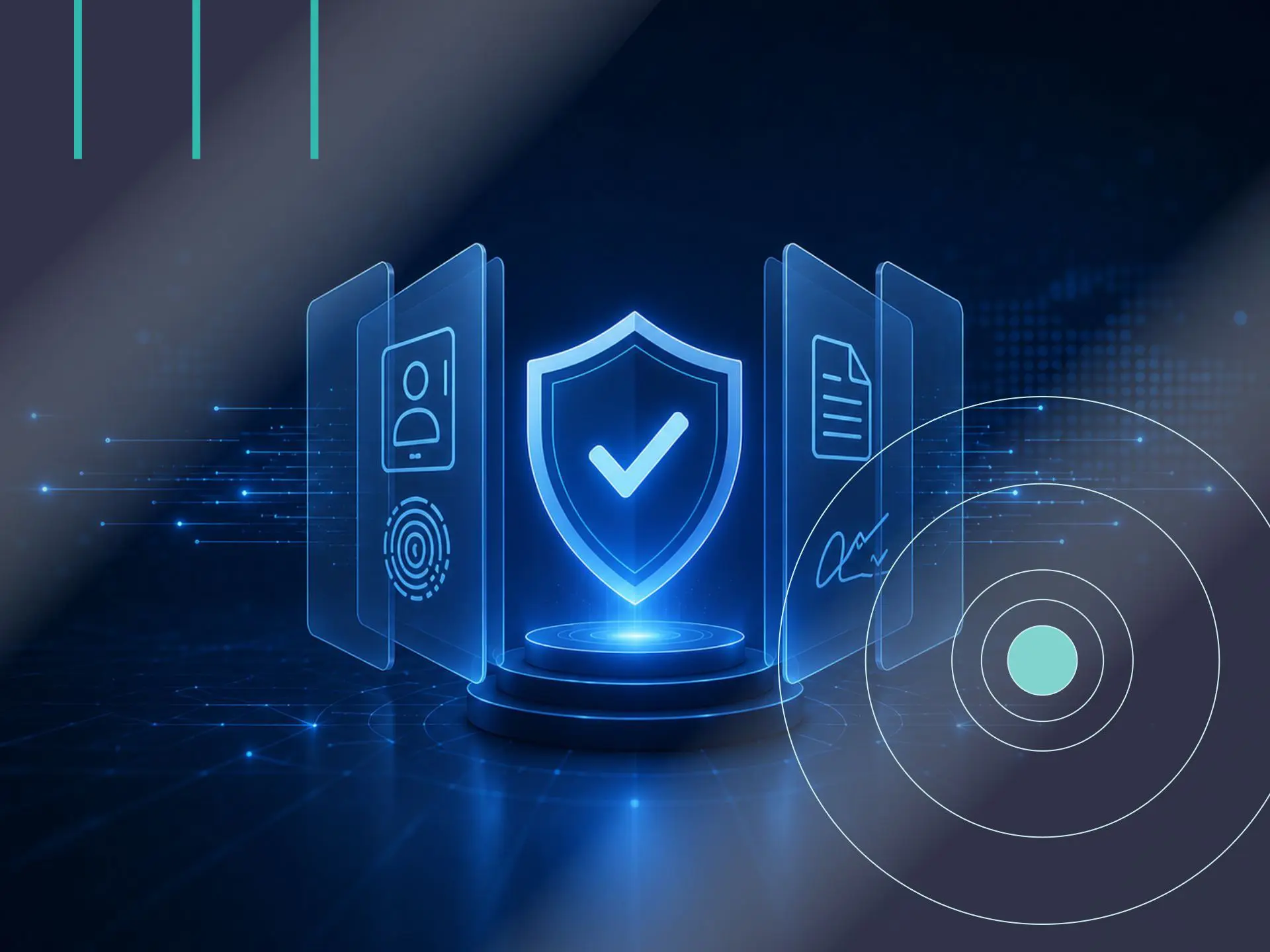
A trust layer is not a feature you bolt on. It is an architectural layer that sits between the agent and the regulated world, ensuring every autonomous action is identifiable, approved, and legally provable.
A genuine trust layer provides three things simultaneously:
- Identity certaint: knowing exactly who (or what) is involved in each process.
- Structured approval: capturing explicit user consent at every critical step.
- Full auditability: maintaining a reliable, tamper-proof trail of every action taken.
When these elements are built into the infrastructure — not layered on top — the equation changes:
- Processes become scalable without becoming brittle.
- Compliance becomes a byproduct of the architecture, not manual overhead.
- Customer confidence grows, because every interaction is verifiable.
The integration problem no one talks about
Today, connecting to onboarding and trust services typically requires building expensive native connectors (Salesforce, SAP, proprietary platforms). These integrations cost millions to build and maintain, and they break every time a vendor updates their API.
This model was already unsustainable for human-driven workflows. For agent-driven workflows, it is impossible. Agents need a standard protocol, a single interface that gives them access to identity verification, document validation, electronic signatures, and AML checks, without bespoke integrations for each service.
This is where the Model Context Protocol (MCP) becomes critical. MCP provides a single standard protocol through which any AI agent – whether it is Microsoft Copilot, Salesforce AgentForce, Claude, or a custom-built system – can consume trust services.
| One integration to build. Infinite agents to serve.
The trust services themselves can be organized as independent, composable hubs: identity verification, document AI, qualified signatures, open banking, AML screening. The agent calls these hubs as needed, but the workflow is controlled by the infrastructure, not the agent’s judgment:
- You cannot sign before verifying identity.
- You cannot approve before validating documents.
- You cannot disburse before completing AML checks.
The sequencing is enforced. Compliance is structural.
From KYC to KYA: Know Your Agent
As agents increasingly act on behalf of users in regulated transactions, a new challenge emerges: how do you know the agent itself is trustworthy?
We are familiar with KYC – Know Your Customer. The agentic economy will require KYA – Know Your Agent.
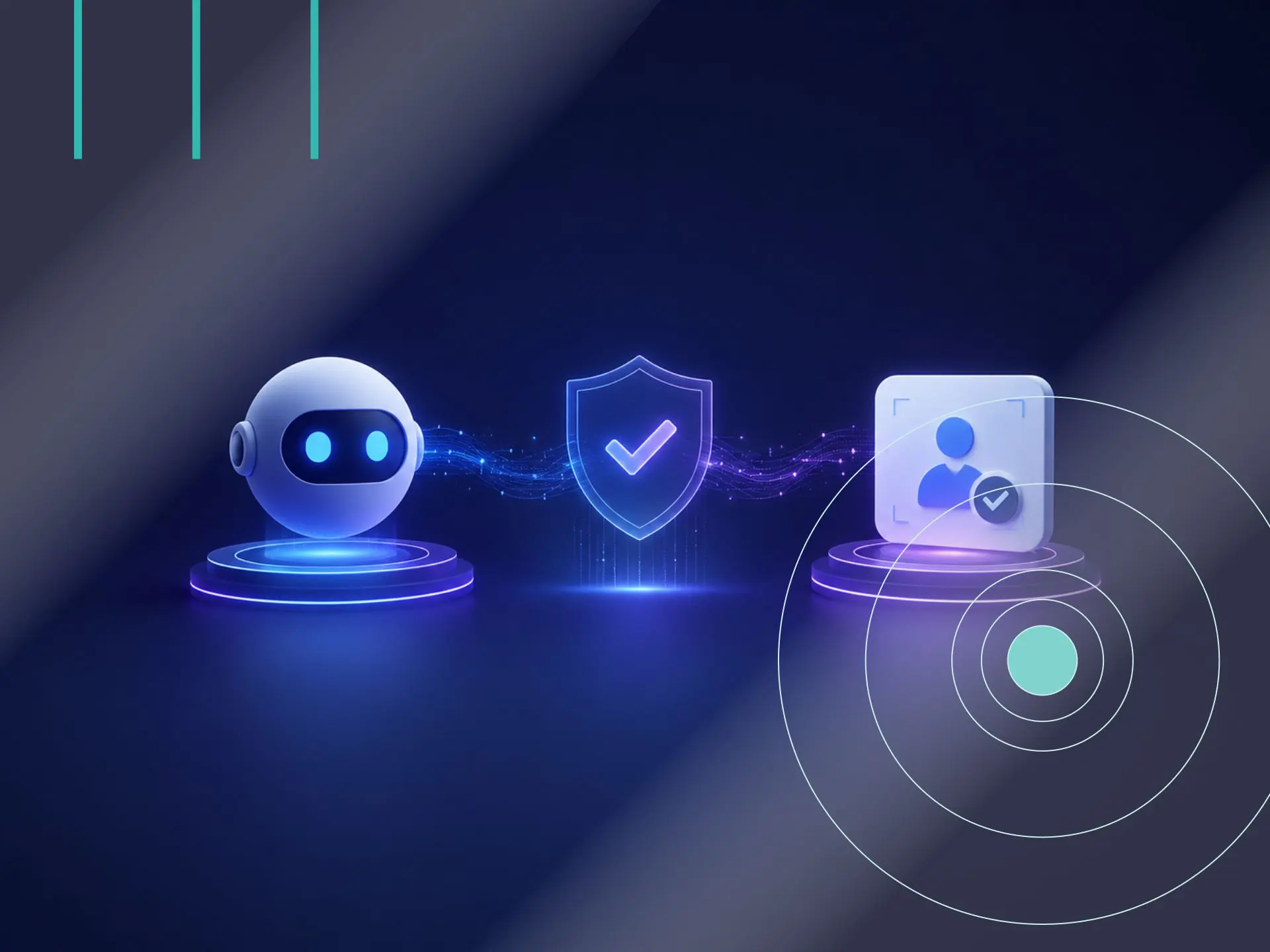
Just as a qualified digital certificate verifies a trusted signer, agent certification verifies that an AI agent is:
- Legitimate – issued by an identifiable, accountable entity.
- Authorized – granted specific, scoped permissions to act on behalf of a user or organization.
- Bounded – operating only within defined regulatory and contractual limits.
The European Digital Identity Wallet (EUDIW) points toward how this becomes practical. The agent performs actions on behalf of the user, and the user validates critical steps via push notification in their wallet, similar to approving a bank payment in a mobile banking app.
The regulatory framework already exists through eIDAS 2.0. What is needed is a Qualified Trust Service Provider (QTSP) that bridges the gap between the agentic world and the regulated one.
Industry estimates suggest that around 10% of agent-to-agent and agent-to-service transactions will require this kind of regulated trust layer: identity, certification, and compliance. That percentage will only grow as autonomous transactions become the norm in financial services, insurance, healthcare, and the public sector.
The regulatory tailwind: eIDAS 2.0, EU AI Act, AMLR
The European regulatory landscape is not slowing the agentic economy down. It is shaping its foundation.
- eIDAS 2.0 introduces the EU Digital Identity Wallet and expands qualified trust services across borders, creating the legal basis for agent-mediated identity and approval.
- The EU AI Act establishes governance requirements for AI systems — transparency, traceability, human oversight — that align directly with what a trust layer delivers.
- AMLR (the EU Anti-Money Laundering Regulation) tightens customer due diligence and ongoing monitoring obligations, making auditable, identity-bound workflows a hard requirement.
Organizations that align their AI strategies with this framework today will be better positioned to scale as enforcement matures. Those that don’t will face compliance retrofits that are far more expensive than building it right the first time.
What this looks like in practice
The trust layer is not abstract. It translates into concrete deployment outcomes:
- Onboarding deployed in 4–8 weeks instead of 6–12 months.
- Integration costs reduced by up to 75%, by replacing native connectors with a single MCP interface.
- Identity verification time cut by up to 70% through multimodal AI (document validation, biometric checks, real-time data analysis).
- End-to-end auditability preserved over the long term through qualified electronic archiving.
- Cross-border legal validity through qualified electronic signatures (QES) under eIDAS.
This is what trusted automation looks like when speed and accountability are designed together.
The real competitive advantage
The next wave of competitive advantage will not come from having the fastest agents. It will come from having agents that can operate in regulated environments with full trust, full traceability, and full legal standing.
Organizations that build this trust infrastructure now – making their services agent-consumable through standard protocols, with role-based access control and end-to-end auditability – will be positioned to lead in the agentic economy.
The question is no longer:
“How fast can we automate?”
It is:
“Can we trust what we are scaling?”
Frequently asked questions
What is a trust layer for AI agents?
A trust layer is the regulated infrastructure that sits between AI agents and the systems they act on, ensuring every autonomous action is linked to a verified identity, backed by explicit approval, and recorded in a tamper-proof audit trail.
What is KYA (Know Your Agent)?
KYA is the agentic-economy equivalent of KYC. It is the process of certifying that an AI agent is legitimate, authorized, and operating within defined regulatory and contractual boundaries — typically through a qualified digital certificate issued by a trust service provider.
How does MCP relate to digital trust?
The Model Context Protocol (MCP) is an open standard that lets any AI agent consume external services through a single, consistent interface. Combined with qualified trust services, MCP makes identity verification, electronic signatures, AML checks, and archiving directly available to agents, without bespoke integrations.
What role does the EU Digital Identity Wallet (EUDIW) play?
EUDIW provides a user-controlled mechanism to approve agent actions in real time, via push notifications backed by qualified credentials under eIDAS 2.0. It is the practical bridge between autonomous agent execution and regulated user consent.
Why does this matter for regulated industries?
In banking, insurance, healthcare, and the public sector, every transaction must be attributable, auditable, and legally valid. Without a trust layer, AI-driven processes in these industries are not deployable at scale.
Namirial is building the trust infrastructure for the agentic economy – making qualified trust services (identity verification, electronic signatures, secure archiving, AML, EUDIW) consumable by any AI agent through a single standard protocol. As a leading European Qualified Trust Service Provider under eIDAS, Namirial is the bridge between autonomous agents and the regulated world.
To learn more about how agent-ready trust services can transform your onboarding workflows, get in touch.
RELATED CONTENT

TRUST
Knock, knock. Who’s there? A new trust layer. Onboarding and AI agents
Two things have made me stop and think over the past few months…
INNOVATION
AI Agents need trust: why we built the Namirial MCP Connector
Artificial Intelligence is rapidly moving beyond chatbots and copilots. We are entering the era of AI agents…