

A structural shift, not a technical footnote
On 1 February 2026, the EU–Singapore Digital Trade Agreement entered into force. While formally a trade instrument, its implications extend well beyond tariff schedules or market access clauses. At its core, the agreement addresses something more fundamental: how digital transactions are recognised, protected, and enabled across jurisdictions.
In a global economy where contracts are executed remotely, onboarding is digital-first, and data flows underpin supply chains, legal certainty around electronic interaction becomes strategic infrastructure. Without it, cross-border operations remain exposed to regulatory ambiguity, fragmented standards, and inconsistent enforceability.
The agreement therefore represents a structural step toward reducing that fragmentation. It reinforces predictability for businesses operating between Europe and Singapore, and it signals a shared commitment to trusted digital frameworks as a foundation for economic cooperation.
What the EU-Singapore Digital Trade Agreement covers: creating predictable digital conditions
The EU–Singapore Digital Trade Agreement provides a structured framework for digital trade cooperation, with particular relevance for:
- The legal recognition of electronic transactions and electronic records
- Cross-border data flows with appropriate safeguards
- Regulatory transparency and cooperation in digital domains
- Reducing unjustified barriers to digital services
For businesses, these elements translate into something tangible: fewer uncertainties when executing electronic contracts, greater clarity around data transfers, and improved alignment in digital regulatory approaches.
Electronic signatures and authentication mechanisms are central in this context. Their enforceability across borders determines whether a transaction can be concluded entirely digitally, without reverting to paper-based or locally anchored processes. Strengthening this recognition directly lowers operational friction.
In practical terms, this reduces time-to-contract, simplifies cross-border onboarding, and supports remote service delivery, all critical in sectors such as financial services, trade finance, logistics, professional services, and regulated industries.
Digital trust as economic infrastructure
Digital trust should be understood not as a compliance layer, but as infrastructure.
When electronic identities are legally recognised and interoperable, businesses can authenticate customers remotely with confidence. When qualified electronic signatures carry enforceability across borders, agreements can be finalised without jurisdictional uncertainty. When data flows are governed by predictable safeguards, organisations can structure regional operations more efficiently.
Each of these elements reduces transaction costs. Together, they enable scalability.
Friction in cross-border trade rarely appears as a single visible barrier. It accumulates through duplicative verification processes, inconsistent legal interpretations, and fragmented compliance obligations. Trusted digital infrastructure addresses these inefficiencies at systemic level.
The EU–Singapore Digital Trade Agreement acknowledges this reality: digital identity and electronic trust services are not peripheral tools, but enablers of cross-border economic activity.
Alignment with EU digital trust architecture: eIDAS2 and the EUDI Wallet
From a European standpoint, the agreement is consistent with the ongoing evolution of the Union’s digital trust framework under the eIDAS Regulation and its revision commonly referred to as eIDAS2.
The revision strengthens the framework for qualified trust services and introduces the European Digital Identity Wallet initiative under the coordination of the European Commission. The objective of the EUDI Wallet is to allow citizens and businesses to hold and use digital identity credentials that are recognised across all EU Member States.
This represents a move toward harmonised, interoperable identity infrastructure within Europe.
The EU–Singapore Digital Trade Agreement does not transpose European law externally. However, it creates compatibility conditions. By reinforcing recognition of electronic transactions and promoting cooperation on digital standards, it supports a trajectory in which European trust services can operate in a broader, internationally aligned environment.
For European companies expanding into Asia-Pacific markets, this alignment reduces uncertainty. For Asian partners, it offers clearer pathways to engage with EU-regulated digital ecosystems.
Singapore’s model: SingPass as proof of concept
Singapore has long demonstrated how government-backed digital identity can operate at scale. Singpass functions as a national digital identity platform enabling secure authentication, digital signing, and access to a wide range of services across both public and private sectors.
Its success lies not only in technology, but in adoption. When digital identity becomes embedded into everyday processes, tax filings, banking, corporate services, healthcare access, it creates network effects. Trust becomes operational, not theoretical.
While governance structures and regulatory approaches differ between Singapore and the EU, there is convergence in direction: both recognise that digital identity must be legally grounded, widely usable, and interoperable to generate economic impact.
The EU–Singapore Digital Trade Agreement creates a framework in which these mature ecosystems can interact more predictably.
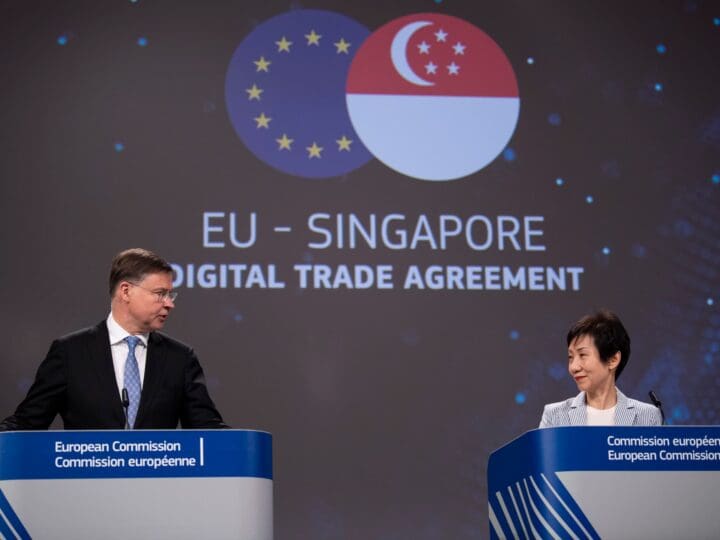
Implications of the EU–Singapore Digital Trade Agreement for Asia-Pacific and ASEAN
Singapore’s position as a regional hub gives the agreement broader relevance across ASEAN.
For companies headquartered in Singapore but operating regionally, stronger alignment with EU digital trade frameworks can facilitate structured expansion into Europe. Conversely, European organisations looking toward Southeast Asia gain greater predictability when using Singapore as an operational base.
This is particularly relevant for sectors dependent on remote onboarding, identity verification, digital signatures, and secure document exchange. As ASEAN markets continue their digital transformation trajectories, interoperability with established trust frameworks becomes increasingly valuable.
In this context, the EU–Singapore Digital Trade Agreement can be seen as a gateway instrument, strengthening a bridge between regulatory ecosystems rather than isolating them.
Namirial’s regional presence and strategic alignment
Namirial’s decision to establish its regional headquarters in Singapore reflects a long-term commitment to Asia-Pacific digital trust development.
Singapore offers regulatory clarity, advanced digital infrastructure, and strong institutional engagement with both Europe and ASEAN. This makes it a strategic base for delivering interoperable trust services aligned with European regulatory standards while responsive to regional market needs.
The agreement reinforces this positioning. It supports an environment where cross-border qualified electronic signatures, digital identity verification, and trust services can be deployed with greater legal confidence.
Interoperability as a design principle
At a strategic level, interoperability must be embedded by design.
Digital trust solutions cannot be confined within national boundaries if businesses operate internationally. Regulatory divergence, if unmanaged, risks recreating digital silos.
The EU–Singapore Digital Trade Agreement contributes to avoiding such silos. By strengthening recognition and promoting regulatory dialogue, it encourages solutions that are compliant across jurisdictions rather than tailored to isolated markets.
For technology providers, this underscores the importance of architecture that anticipates cross-border enforceability. For enterprises, it supports investment in digital trust solutions that scale beyond domestic markets.
What comes next: adoption, convergence, scale
The entry into force of the EU-Singapore Digital Trade Agreement marks a starting point for deeper operational integration.
In the coming years, its impact will depend on:
- Continued regulatory cooperation and standards dialogue
- Practical implementation by businesses and service providers
- Adoption of interoperable digital identity and trust services
For policymakers, the objective will be to maintain alignment while respecting different legal traditions.
For enterprises, the opportunity lies in accelerating digital transformation with greater cross-border certainty.
For digital trust providers, the focus will be on delivering solutions that are robust, compliant, and adaptable to converging frameworks.
Ultimately, the EU–Singapore Digital Trade Agreement reinforces a broader trajectory: digital trust is becoming shared infrastructure. As cross-border economic activity increasingly depends on secure, legally recognised digital interaction, frameworks that reduce fragmentation will define competitiveness.
The agreement signals that trusted digital infrastructure is not an adjunct to economic strategy, it is integral to it.